
Yeast-Based Expression for Enzymes, Diagnostic Proteins, Antibody Fragments, and Genetic Medicine Components
Not every recombinant protein belongs in E. coli.
Some proteins need a more eukaryotic expression environment. Some benefit from secretion. Some require better folding support. Some need disulfide bond formation. Some are too difficult, unstable, insoluble, or poorly behaved in bacterial systems. Some proteins are meant for diagnostics, enzyme workflows, assay systems, antibody-fragment platforms, or genetic medicine applications where function matters more than simply producing material.
That is where yeast expression becomes valuable.
At Xoligo Biologics, we support Pichia / yeast expression services for companies developing recombinant enzymes, diagnostic proteins, assay-ready proteins, antibody fragments, secreted proteins, difficult eukaryotic targets, glycoprotein-adjacent components, and pre-GMP biological materials.
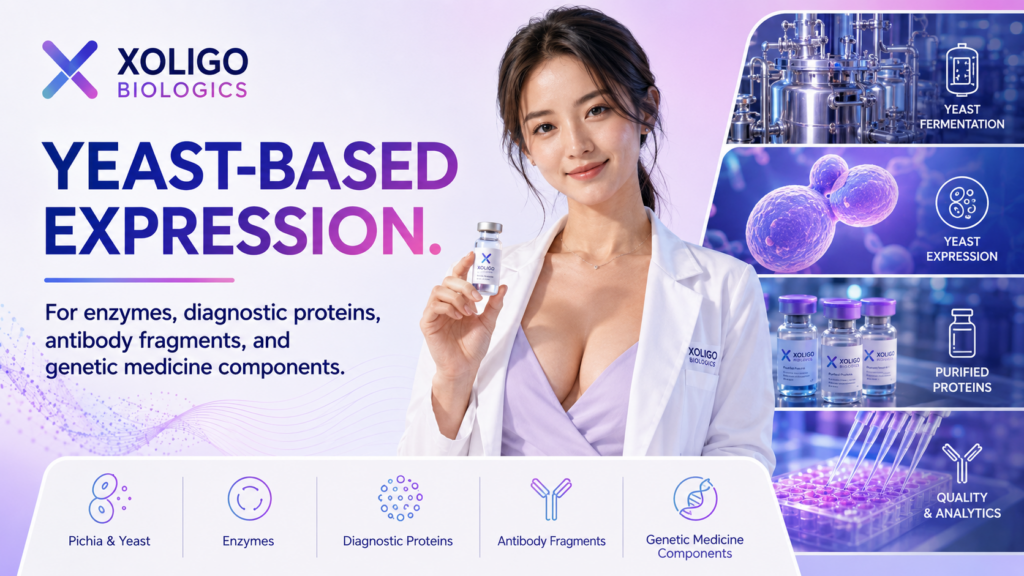
Xoligo is a Component CDMO for genetic medicine, diagnostics, and precision biomanufacturing. That means we do not treat yeast expression as a standalone microbial service. We treat it as one of the production systems that helps connect the larger molecular stack: oligonucleotides, RNA, plasmids, enzymes, proteins, assays, fermentation, analytics, QC, and transfer-ready manufacturing support.
From Cambridge, we support program strategy, modality planning, and scientific design. From Montreal, we support nucleic acid development, analytical characterization, RNA workflows, and GMP-pathway planning. From Frederick, Maryland, we support recombinant protein production, microbial expression, enzyme manufacturing, diagnostic components, and pre-GMP bridge material.
Together, those locations allow Xoligo to support yeast expression not as a generic manufacturing route, but as a practical development path for proteins that need more than bacterial speed.
Why Yeast Expression Matters
Yeast expression systems occupy an important middle ground in recombinant protein production.
They are microbial, scalable, and cost-effective, but they also offer some eukaryotic advantages that bacterial systems cannot always provide. For certain proteins, yeast can improve folding, secretion, solubility, disulfide bond formation, and downstream purification.
Pichia pastoris, Komagataella phaffii, Saccharomyces cerevisiae, and other yeast platforms have been used for enzymes, diagnostic proteins, antigens, antibody fragments, growth factors, industrial proteins, and research reagents. The system is especially useful when a protein is too difficult for E. coli but does not necessarily require full mammalian expression.
For Xoligo, yeast expression is not just another host option.
It is a bridge.
It gives customers a path between bacterial expression and mammalian production. It allows programs to explore secretion, improved folding, and microbial scalability. It supports diagnostic and enzyme manufacturing logic. It helps companies produce proteins that need better behavior without immediately moving into a more expensive or complex system.
That flexibility matters for modern genetic medicine and diagnostics because many programs need proteins that are functional, affordable, repeatable, and compatible with downstream workflows.
Pichia Expression for Recombinant Enzymes
Recombinant enzymes are one of the strongest use cases for yeast expression.
Many enzymes used in diagnostics, RNA workflows, molecular biology, industrial biotechnology, assay systems, and research tools can benefit from yeast-based production when bacterial expression creates solubility, activity, or purification challenges.
Xoligo supports yeast expression for enzymes such as:
RNA workflow enzymes
Diagnostic enzymes
Ligases
Nucleases
Polymerase-adjacent proteins
Proteases
Oxidases
Dehydrogenases
Phosphatases
Reporter enzymes
Assay enzymes
Industrial and research enzymes
Custom recombinant enzymes
Some enzymes express well intracellularly. Others benefit from secretion into the culture medium, which can simplify downstream purification and reduce host-cell impurity burden. The best strategy depends on the enzyme’s structure, function, stability, intended use, and downstream process.
For RNA and genetic medicine customers, yeast expression can support enzyme components that are used in plasmid-to-RNA workflows, diagnostic systems, QC assays, or reagent manufacturing.
For diagnostic customers, yeast can support enzyme manufacturing where activity, stability, and repeatability are more important than maximizing expression alone.
The goal is not simply to produce enzyme mass.
The goal is to produce enzyme function.
Diagnostic Proteins and Assay Components
Diagnostic proteins must be produced with the assay in mind.
A protein intended for a diagnostic kit, biosensor, immunoassay, molecular assay, clinical reagent system, or companion diagnostic must perform reliably under real assay conditions. It may need to remain stable during storage, avoid aggregation, produce consistent signal, bind correctly, support calibration, or function in combination with enzymes, oligonucleotides, antibodies, or other reagent components.
Xoligo supports yeast expression for diagnostic proteins and assay-ready components, including:
Recombinant antigens
Control proteins
Calibrators
Standards
Assay enzymes
Binding proteins
Receptor domains
Reporter proteins
Antibody fragments
Fusion proteins
Kit components
Custom reagent proteins
Yeast can be particularly useful when diagnostic proteins need better folding than E. coli can provide, but the customer still wants a scalable microbial process.
This is one of the areas where Xoligo’s model connects strongly with diagnostic contract manufacturing. We understand that a diagnostic customer does not only need one technically successful expression run. They need repeatable supply, documentation, stability, and component performance inside the assay.
A protein is not diagnostic-ready because it was expressed.
It is diagnostic-ready because it performs consistently.
Secreted Protein Expression
One of the major advantages of yeast expression is the potential for secreted protein production.
Secretion can simplify purification, improve folding for certain proteins, support disulfide bond formation, and reduce the amount of intracellular host-cell material that must be removed later.
Xoligo supports secreted expression development for proteins such as enzymes, antigens, binding proteins, antibody fragments, receptor domains, assay proteins, and diagnostic components.
Development considerations may include:
Signal peptide selection
Construct design
Codon optimization
Expression vector strategy
Host strain selection
Media and feeding strategy
Induction strategy
Harvest timing
Supernatant clarification
Proteolysis control
Purification development
Stability screening
Secreted expression is powerful, but it is not automatic. Some proteins secrete poorly. Some degrade in the medium. Some require optimization of signal sequences, culture conditions, or downstream capture. Some may need alternative host or construct strategies.
Xoligo helps evaluate whether secretion is the correct route and, when it is, how to make the process practical.
Antibody Fragments, VHHs, scFvs, and Binding Proteins
Yeast expression can be useful for antibody fragments and recombinant binders.
VHHs, scFvs, Fab fragments, antibody scaffolds, engineered binders, and Fc-adjacent constructs may be used in diagnostics, imaging, targeted delivery, biosensors, research tools, cell therapy workflows, and therapeutic discovery.
Some antibody fragments express well in E. coli. Others benefit from yeast secretion, eukaryotic folding, or improved downstream behavior. The correct platform depends on format, sequence, disulfide structure, aggregation behavior, target use, and scale requirements.
Xoligo supports yeast expression for antibody fragments and binding proteins with attention to:
Construct design
Tag selection
Signal peptide strategy
Secreted versus intracellular expression
Binding preservation
Aggregation control
Purification strategy
Endotoxin profile
Assay compatibility
Stability and formulation
This service connects directly to Xoligo’s VHH and Antibody Fragment Production page, Assay-Ready Recombinant Protein Production page, Diagnostic Enzyme Contract Manufacturing page, and Protein-Oligo Conjugate Development page.
The commercial opportunity is strong because antibody fragments are no longer just research molecules. They are assay components, diagnostic binders, targeting elements, imaging tools, and building blocks for advanced therapeutic systems.
Glycoprotein-Adjacent and Difficult Eukaryotic Proteins
Some proteins are not ideal for bacterial expression.
They may require disulfide bonds, eukaryotic folding support, secretion, partial glycosylation, improved solubility, or a more flexible host environment. Yeast can sometimes provide a better path for these difficult targets while remaining less expensive and more scalable than mammalian expression.
Xoligo supports yeast-based feasibility and development work for difficult eukaryotic proteins, including selected receptor domains, enzymes, secreted proteins, antigens, binding proteins, growth-factor-like proteins, and assay proteins.
This does not mean yeast is always the answer. Some proteins truly require mammalian expression. Some need specific glycosylation patterns that yeast may not provide. Some are better suited for E. coli, insect, or mammalian systems.
Xoligo’s advantage is host-neutral judgment.
We help customers decide whether yeast is the correct system, not simply sell yeast as the answer to every problem.
Strain, Construct, and Expression Strategy
Successful yeast expression begins with design.
A protein may fail because the host is wrong, but it may also fail because the construct is wrong. Domain boundaries, secretion signals, codon usage, tags, cleavage sites, linker design, promoter choice, and expression conditions can all determine success.
Xoligo supports yeast expression strategy including:
Sequence review
Codon optimization
Construct design
Signal peptide evaluation
Tag placement
Promoter strategy
Host selection
Secretion strategy
Expression screening
Clone or strain evaluation
Small-scale feasibility testing
Purification-aware design
For secreted proteins, signal peptide selection and proteolysis control can become critical.
For antibody fragments, disulfide formation and aggregation risk matter. For enzymes, activity preservation and stability matter. For diagnostic proteins, assay performance matters. For pre-GMP bridge material, documentation and transferability matter.
Xoligo designs yeast expression programs around the final use of the protein.
Fermentation Development and Scale-Up
Yeast expression becomes especially valuable when a process needs to scale.
Pichia and other yeast systems can support high-cell-density fermentation and efficient production of recombinant proteins. But scale-up requires process control.
Fermentation variables such as carbon source, feeding strategy, oxygen transfer, pH, temperature, induction timing, protease activity, cell density, harvest timing, and media composition can influence yield, product quality, impurity profile, and downstream purification.
Xoligo supports yeast fermentation development for recombinant enzymes, diagnostic proteins, assay-ready proteins, antibody fragments, and pre-GMP components.
Programs may begin with small-scale feasibility and move toward larger production runs, engineering lots, diagnostic reagent supply, or transfer-ready process packages.
The objective is not simply to demonstrate expression.
The objective is to build a process that can be repeated and scaled.
Purification and Downstream Processing
Yeast expression can simplify some downstream challenges, but it also introduces its own process considerations.
Secreted proteins may require clarification, capture from supernatant, concentration, buffer exchange, impurity removal, protease management, and polishing. Intracellular proteins require lysis, clarification, and purification similar to other microbial systems.
Xoligo supports downstream development including:
Clarification
Affinity capture
Ion exchange chromatography
Hydrophobic interaction chromatography
Size exclusion chromatography
Polishing steps
Protease removal
Host cell protein reduction
Host cell DNA reduction
Endotoxin and impurity evaluation
Buffer exchange
Concentration
Formulation screening
Stability support
The purification process must be shaped by the protein’s intended application.
An enzyme needs activity.
An antigen needs binding and presentation.
An antibody fragment needs affinity and stability.
A diagnostic component needs consistency.
A pre-GMP material needs documentation and comparability.
Purification is not just cleanup.
It is where the protein becomes usable.
Analytical Characterization
Yeast-derived proteins require characterization that matches their intended use.
Xoligo supports analytical packages that may include:
SDS-PAGE
Western blotting
Protein concentration
Purity assessment
Identity confirmation
Molecular weight analysis
LC-MS support
Activity assays
Binding assays
Aggregation analysis
Host cell protein evaluation
Host cell DNA evaluation
Stability studies
Lot-to-lot comparison
Formulation compatibility
Documentation packages
For some proteins, additional characterization may be needed around glycosylation, proteolysis, bioactivity, or assay-specific performance.
The point is to generate data that helps customers make development decisions.
A protein should not simply be delivered.
It should be understood.
Yeast Expression for Pre-GMP Bridge Material
Many companies need material before they are ready for full GMP manufacturing.
This is especially true for diagnostic developers, RNA companies, CRISPR companies, vaccine researchers, assay developers, and biotech startups that need enough material to support internal testing, partner studies, toxicology-support work, or early CMC planning.
Xoligo supports pre-GMP bridge material from yeast expression programs, including engineering lots, scale-up batches, characterization packages, batch records, process summaries, comparability support, and transfer documentation.
This helps customers move from exploratory science toward serious development without immediately forcing the program into a full GMP manufacturing commitment.
The right early process can save major time later.
Yeast Expression in the Xoligo System
Yeast expression becomes more valuable when it is connected to Xoligo’s broader platform.
A customer developing an RNA therapeutic may also need RNA enzymes, plasmid-to-RNA workflow support, analytical characterization, and assay proteins. A diagnostic customer may need oligonucleotides, enzymes, antigens, controls, calibrators, and kit-compatible reagent components. A CRISPR customer may need Cas enzymes, guide RNAs, protein standards, and activity assays. A research-tool company may need custom proteins, antibody fragments, and repeat production.
Yeast expression fits into all of these systems.
It gives Xoligo another production route for the proteins that support genetic medicine and diagnostics.
That is why this service is not isolated. It connects naturally to:
RNA Enzyme Manufacturing Services
Diagnostic Enzyme Contract Manufacturing
Assay-Ready Recombinant Protein Production
VHH and Antibody Fragment Production
Protein-Oligo Conjugate Development
Reference Standards, Controls, and Calibrators
Pre-GMP Bridge Material Services
Comparability and Tech Transfer Packages
The Xoligo model is not built around one molecule type.
It is built around the components that make modern biotechnology work.
Why Xoligo
Xoligo supports yeast expression with a practical, application-aware mindset.
We understand that customers are not buying expression for its own sake. They are trying to solve a development problem.
They may need a secreted enzyme.
They may need a diagnostic antigen.
They may need a stable antibody fragment.
They may need a protein that failed in E. coli.
They may need a scalable microbial system.
They may need pre-GMP bridge material.
They may need assay-ready protein supply.
They may need better documentation before transfer.
Xoligo brings together microbial expression, recombinant protein development, enzyme manufacturing, oligonucleotide workflows, RNA systems, diagnostics, analytics, and transfer-ready development.
That combination makes yeast expression more useful because it is connected to the rest of the program.
From Yeast Expression to Functional Components
Yeast expression is not just an alternative to E. coli.
It is a strategic production route for proteins that need better folding, secretion, stability, or downstream behavior while still benefiting from microbial scalability.
For Xoligo customers, that can mean better enzymes, better diagnostic proteins, better antibody fragments, better assay components, and stronger pre-GMP development paths.
Whether your team is developing a secreted enzyme, recombinant antigen, assay protein, VHH, scFv, receptor domain, diagnostic reagent, or difficult eukaryotic component, Xoligo helps determine whether yeast expression can move the program forward.
Because the goal is not simply to express the protein.
The goal is to produce a functional component that helps the entire system work.