
At Xoligo Biologics, we specialize in nucleic acid therapeutics—mRNA, oligonucleotides, Services
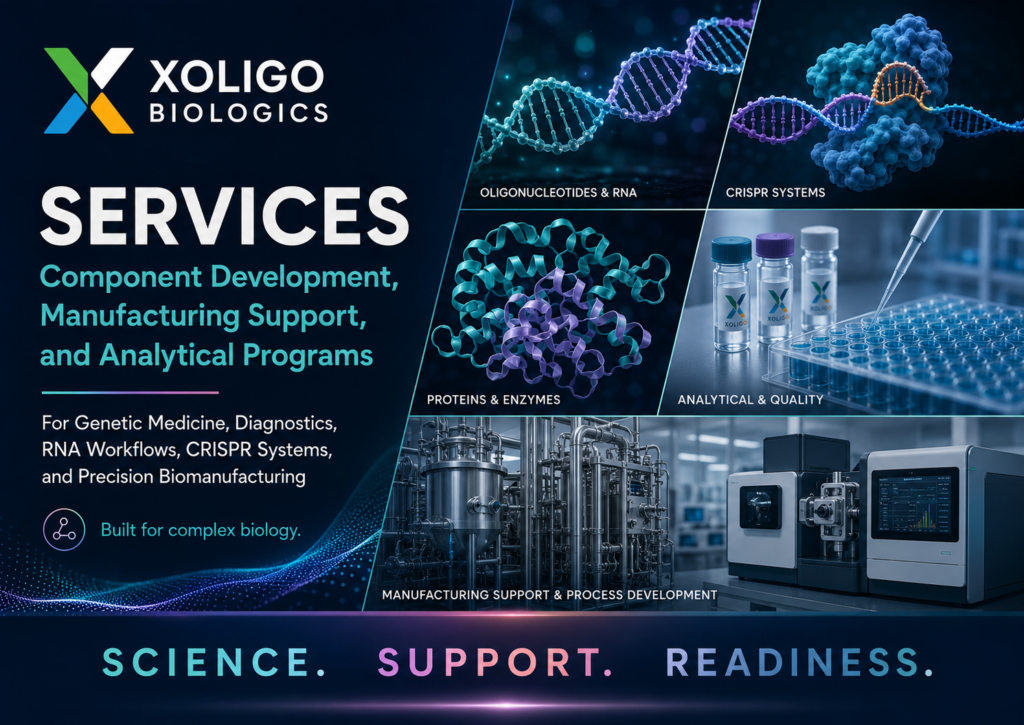
Component Development, Manufacturing Support, and Analytical Programs for Genetic Medicine, Diagnostics, RNA Workflows, CRISPR Systems, and Precision Biomanufacturing
Xoligo Biologics supports the component layer behind modern biotechnology.
Genetic medicine, diagnostics, RNA therapeutics, CRISPR platforms, molecular testing, and precision biomanufacturing do not depend on one molecule alone. They depend on connected systems: oligonucleotides, RNA, plasmids, recombinant enzymes, CRISPR proteins, diagnostic reagents, assay-ready proteins, antibody fragments, microbial fermentation, analytical characterization, controls, calibrators, stability programs, and transfer-ready documentation.
That is where Xoligo works.
We are a Component CDMO for companies that need more than catalogue reagents and more focus than a broad, generic contract manufacturer. Xoligo supports the development and manufacturing path for the biological components that make advanced platforms function.
A diagnostic assay needs enzymes, probes, controls, calibrators, and stable reagent systems.
An RNA therapeutic workflow needs plasmid templates, IVT enzymes, RNA integrity analysis, purification logic, and formulation-readiness.
A CRISPR program needs Cas enzymes, guide RNAs, reporter systems, functional assays, and matched controls.
A recombinant protein program needs expression, purification, activity testing, stability, and transfer documentation.
A pre-GMP development program needs material that can be understood, compared, and moved forward.
Xoligo brings those layers together.
Our services are organized around the major technical needs of modern genetic medicine and diagnostic development: oligonucleotide development, RNA workflows, CRISPR and gene editing support, plasmid DNA development, enzyme and protein component production, microbial fermentation, analytical characterization, GMP-pathway planning, process development, scale-up, tech transfer, and CMC support.
Oligonucleotide Development
Oligonucleotides are the foundation of many modern biotechnology programs.
They guide enzymes, control gene expression, define diagnostic specificity, support CRISPR systems, act as primers and probes, form aptamers, become conjugates, and function as standards, controls, or therapeutic candidates.
Xoligo supports oligonucleotide development for ASOs, siRNA, miRNA and RNAi components, aptamers, guide RNAs, diagnostic primers and probes, modified oligonucleotides, oligo conjugates, nucleic acid controls, and pre-GMP development materials.
Our work can include sequence review, modification strategy, impurity profiling, analytical characterization, duplex evaluation, conjugation-readiness, diagnostic compatibility, stability support, and transfer-aware documentation.
For therapeutic developers, this may mean helping an ASO, siRNA, gRNA, or modified oligo move from early research material toward a more defined development package.
For diagnostic developers, it may mean primers, probes, reporter oligos, controls, and standards that support consistent assay performance. For CRISPR companies, it may mean guide RNAs that are evaluated alongside the Cas enzyme and assay readout.
Xoligo treats oligos not only as chemical strands, but as functional components inside biological systems.
mRNA and RNA Therapeutics
RNA programs require coordination between template design, enzyme systems, RNA production, purification, integrity analysis, formulation-readiness, and stability.
Xoligo supports mRNA and RNA therapeutic component development across early research, pre-GMP bridge material, diagnostic control material, and transfer-ready workflows.
Our RNA-related services may include plasmid-to-RNA workflow development, IVT process support, RNA enzyme manufacturing, RNA integrity and fragment analysis, residual impurity testing, LNP compatibility screening, stability studies, and documentation packages.
We support mRNA, self-amplifying RNA, circular RNA, guide RNA, diagnostic RNA controls, RNA standards, and custom RNA components.
RNA quality depends on more than the final transcript. It depends on the plasmid template, linearization strategy, polymerase performance, capping workflow, nuclease control, purification process, storage, and analytical method. Xoligo connects these pieces so customers can understand why an RNA material performs well, fails, fragments, or changes between lots.
The goal is practical: better RNA material, better data, and a clearer path toward the next development stage.
CRISPR and Gene Editing Support
CRISPR systems are component systems.
A functional CRISPR workflow may require a Cas enzyme, guide RNA, target sequence, donor template, reporter oligo, diagnostic control, activity assay, delivery context, and stability strategy. If one part fails, the whole system can become difficult to interpret.
Xoligo supports CRISPR and gene editing programs through Cas enzyme production, guide RNA development, CRISPR diagnostic component manufacturing, functional assay support, reporter oligo development, reference material generation, and pre-GMP bridge material planning.
We can support Cas9, Cas12, Cas13, nickases, dCas systems, base-editing components, prime-editing components, guide RNAs, sgRNAs, crRNAs, reporter systems, screening components, and diagnostic CRISPR reagents.
Our approach is not only to make a Cas protein or guide RNA. It is to help the customer understand the system: does the enzyme retain activity, does the guide remain intact, does the reporter produce signal, does the buffer support the reaction, do residual impurities affect performance, and can the component set be compared between lots?
CRISPR development becomes stronger when the parts are designed, tested, and documented together.
Plasmid DNA Development
Plasmids are upstream of many RNA, protein, enzyme, and genetic medicine workflows.
They may function as IVT templates, expression constructs, reference controls, diagnostic standards, donor templates, research plasmids, or pre-GMP development materials. A weak plasmid design can create downstream problems in RNA production, recombinant protein expression, CRISPR workflows, and analytical comparability.
Xoligo supports plasmid DNA development and plasmid-to-RNA workflow planning with attention to template design, sequence architecture, linearization strategy, expression use, analytical requirements, and future transfer.
For RNA programs, plasmid quality influences transcript yield, integrity, fragment profile, residual DNA burden, and reproducibility. For recombinant protein programs, construct design affects expression, folding, solubility, purification, and function. For diagnostic programs, plasmid controls must remain consistent, quantifiable, and appropriate for the assay.
Xoligo helps customers treat plasmids as development-critical materials, not administrative starting points.
Enzyme and Protein Component Production
Modern biotechnology runs on proteins.
Some are final products. Many are tools, process components, diagnostic reagents, standards, controls, assay materials, or hidden infrastructure behind a larger platform.
Xoligo supports enzyme and protein component production for RNA workflows, diagnostics, molecular testing, CRISPR systems, assay development, research tools, pre-GMP bridge material, and genetic medicine programs.
Our work includes recombinant enzyme development, RNA enzyme manufacturing, diagnostic enzyme contract manufacturing, assay-ready recombinant protein production, antigen production, antibody fragment production, VHH and scFv development, protein-oligo system support, and activity or binding assay development.
Examples of supported enzyme and protein categories include polymerases, reverse transcriptases, capping enzymes, ligases, nucleases, restriction enzymes, RNase inhibitors, Cas enzymes, diagnostic enzymes, oxidases, dehydrogenases, peroxidases, recombinant antigens, cytokines, receptor proteins, VHHs, scFvs, Fabs, and protein standards.
The central question is always function.
Does the enzyme work in the intended workflow?
Does the protein bind in the intended assay?
Does the antigen present the correct epitope?
Does the Cas protein support editing or detection?
Does the material remain stable after storage?
Xoligo develops components around those questions.
Microbial Fermentation
Microbial fermentation is one of the practical engines behind genetic medicine, diagnostics, and reagent manufacturing.
Xoligo supports microbial fermentation for recombinant enzymes, CRISPR proteins, diagnostic reagents, assay proteins, antigens, VHHs, scFvs, standards, controls, and pre-GMP bridge material.
E. coli can provide fast, scalable production for many enzymes, Cas proteins, antigens, assay proteins, and antibody fragments. Yeast and Pichia systems may support secretion, folding, disulfide handling, and microbial production of proteins that are not ideal for bacterial expression.
Fermentation is not judged only by expression level. A useful process must produce material that can be purified, characterized, stabilized, tested, and transferred. High expression is not enough if the product is inactive, aggregated, impurity-heavy, unstable, or difficult to reproduce.
Xoligo connects upstream fermentation to downstream purification, residual host cell DNA and protein testing, endotoxin and bioburden reduction, activity assays, stability studies, and CMC documentation.
The goal is not simply to grow cells.
The goal is to produce functional biological components that support the customer’s next milestone.
Analytical and Characterization Services
Analytical characterization turns material into usable development evidence.
Xoligo supports analytical and characterization services for oligonucleotides, RNA, recombinant proteins, enzymes, CRISPR components, diagnostic reagents, antibody fragments, protein-oligo conjugates, standards, controls, and pre-GMP materials.
Our analytical support may include oligonucleotide impurity profiling, RNA integrity and fragment analysis, residual host cell DNA testing, residual host cell protein testing, endotoxin and bioburden awareness, enzyme activity testing, binding assays, functional assays, stability studies, lot comparability, and transfer-package documentation.
The purpose of analytics is not to produce data for its own sake. The purpose is to answer development questions.
Is the oligo pure enough?
Is the RNA intact?
Is the enzyme active?
Is the protein stable?
Are host impurities interfering with performance?
Is a new lot comparable to the previous lot?
Can this material support diagnostic validation, preclinical work, customer sampling, or transfer?
Xoligo builds analytical programs around the intended use of the component.
GMP Manufacturing and GMP-Pathway Support
Not every program begins at GMP.
Many companies need a staged path from research material to pre-GMP bridge material, then toward GMP manufacturing, IVD manufacturing, clinical-grade pathways, or partner transfer.
Xoligo supports GMP-pathway planning for genetic medicine and diagnostic components by helping customers define what level of material, documentation, testing, and process control is appropriate for the current stage.
This may include research-grade material, feasibility lots, validation lots, pre-GMP bridge material, IND-enabling material support, diagnostic reagent transfer packages, clinical-grade manufacturing pathway planning, and CMC documentation.
Xoligo is careful about quality claims. Material is not GMP unless produced under an appropriate GMP quality system. But early material can still be developed with stronger discipline, better documentation, clearer analytical methods, and a cleaner transfer path.
That is often the most useful middle ground.
Xoligo helps customers avoid two common mistakes: overbuilding too early and underbuilding too long.
Process Development and Scale-Up
Process development is where a promising component becomes a more reliable manufacturing program.
Xoligo supports process development and scale-up for oligonucleotides, RNA workflows, recombinant enzymes, diagnostic reagents, CRISPR proteins, assay-ready proteins, microbial fermentation products, and pre-GMP biological materials.
Process development may involve expression optimization, fermentation conditions, purification strategy, impurity reduction, enzyme activity preservation, RNA workflow improvement, formulation screening, stability support, lyophilization-readiness, analytical method development, and lot comparability.
Scale-up is not only about making more material. It is about preserving the right attributes as scale changes.
A process that works at small scale may reveal new problems at larger scale: aggregation, impurities, lower activity, stability drift, altered RNA integrity, purification bottlenecks, or inconsistent diagnostic signal.
Xoligo helps customers identify these risks early and build processes that are easier to transfer, compare, and improve.
Tech Transfer and CMC Support
Development work becomes more valuable when it can be transferred.
Xoligo supports tech transfer and CMC packages for RNA, oligonucleotides, enzymes, CRISPR components, diagnostic reagents, recombinant proteins, antibody fragments, protein-oligo conjugates, standards, controls, and pre-GMP bridge materials.
A strong package may include process summaries, batch history, specifications, analytical data, activity results, impurity profiles, stability information, storage recommendations, certificates of analysis, comparability summaries, and future manufacturing recommendations.
The purpose is to help the next team understand the material.
What was made?
How was it made?
How did it perform?
What changed between lots?
What risks remain?
What should be preserved during transfer?
This support is useful for companies moving to a GMP CDMO, diagnostic manufacturer, formulation partner, internal manufacturing team, strategic partner, or investor diligence process.
Xoligo helps turn scattered development work into transferable value.
How Xoligo Services Work Together
Xoligo’s services are modular, but they are designed to connect.
A customer may enter through one service and discover that a neighboring capability is needed. An enzyme manufacturing project may require endotoxin reduction and activity assays. A diagnostic reagent program may require controls, calibrators, and stability studies. An RNA workflow may require plasmid review, enzyme compatibility, RNA integrity analysis, and LNP screening. A CRISPR diagnostic system may require Cas enzyme production, guide RNA development, reporter oligos, target controls, and matched functional testing.
That is the advantage of a component CDMO model.
Xoligo can support individual pieces, but the company is strongest when those pieces need to work together.
Service Areas
Xoligo’s service platform includes:
Oligonucleotide Development
mRNA and RNA Therapeutic Component Development
CRISPR and Gene Editing Support
Plasmid DNA Development
Enzyme and Protein Component Production
Microbial Fermentation
Analytical and Characterization Services
GMP Manufacturing Pathway Support
Process Development and Scale-Up
Tech Transfer and CMC Support
Diagnostic Reagent Manufacturing
Reference Standards, Controls and Calibrators
Lyophilization and Stabilization
Potency and Functional Assay Development
Pre-GMP Bridge Material
Protein-Oligo System Development
Each service can stand alone, but the deeper value comes from integration.
Who We Support
Xoligo supports biotechnology companies, diagnostic developers, genetic medicine teams, RNA therapeutic companies, CRISPR platform companies, research-tool developers, reagent manufacturers, CDMOs, CROs, and emerging startups that need component development support.
Typical customer situations include:
A diagnostic company needs a second source for a critical enzyme.
An RNA company needs IVT workflow support and RNA integrity analysis.
A CRISPR platform needs Cas protein, guide RNA, and reporter system development.
A startup needs pre-GMP bridge material before approaching a larger CDMO.
A reagent company needs stabilized controls, calibrators, or standards.
A research-tool company needs assay-ready proteins or antibody fragments.
A genetic medicine program needs process documentation before transfer.
Xoligo is built for programs where technical details matter but the path is still evolving.
The Xoligo Standard
Xoligo evaluates components by their ability to support the next milestone.
The standard is not simply whether material exists.
The standard is whether the material is fit for purpose.
That means asking whether the component performs, whether impurities are understood, whether the assay can interpret it, whether stability is sufficient, whether the next lot can be compared, and whether the material can transfer into the next development stage.
That is the foundation of Xoligo’s service model.
From Strands to Systems
Modern biotechnology is becoming more connected.
Oligos guide proteins.
Enzymes make RNA.
RNA requires plasmids.
Diagnostics require controls.
CRISPR requires matched components.
Proteins require functional testing.
Reagents require stability.
Manufacturing requires documentation.
Transfer requires comparability.
Xoligo Biologics supports that connected layer.
We help customers move from individual molecules to functional systems, from research material to pre-GMP confidence, from assay ideas to diagnostic components, and from fragmented development to clearer manufacturing pathways.
Precision strands. Functional systems. Clinical-ready components.