
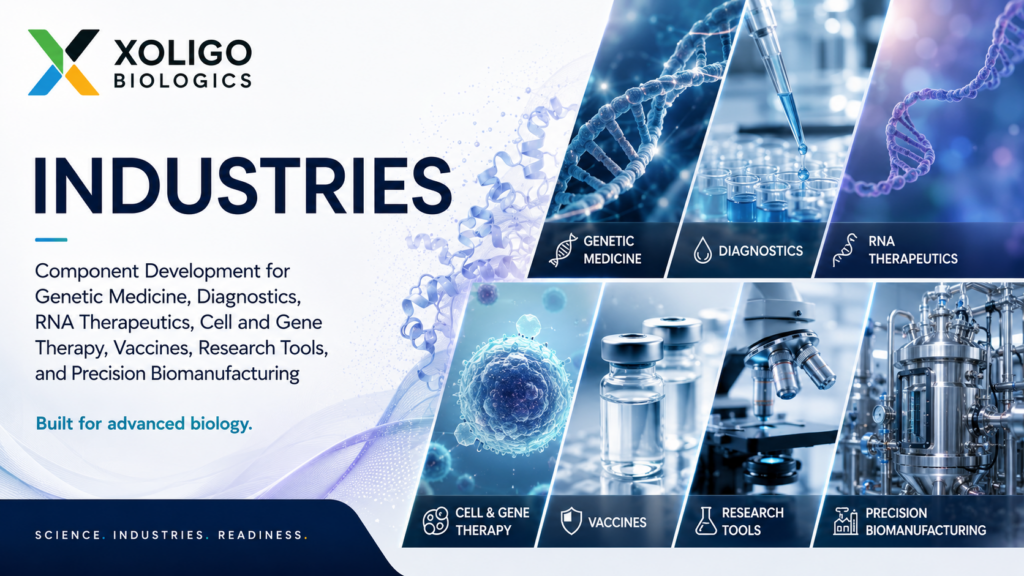
Component Development for Genetic Medicine, Diagnostics, RNA Therapeutics, Cell and Gene Therapy, Vaccines, Research Tools, and Precision Biomanufacturing
Xoligo Biologics supports industries where biological components determine whether a program can move forward.
The market may call them genetic medicines, diagnostics, RNA therapeutics, cell and gene therapies, vaccines, immunology tools, research reagents, molecular assays, or precision biomanufacturing programs. Underneath those categories, the same technical truth appears again and again: advanced biotechnology depends on functional components.
An RNA therapeutic needs template DNA, IVT enzymes, RNA integrity, purification logic, stability, formulation-readiness, and analytical support. A diagnostic system needs primers, probes, enzymes, antigens, controls, calibrators, standards, liquid reagents, lyophilized reagents, and lot comparability. A CRISPR company needs Cas proteins, guide RNAs, donor templates, reporter oligos, activity assays, and matched reference materials.
A vaccine or immunology program may need antigens, RNA components, assay proteins, controls, potency methods, and stability data. A research-tool company may need recombinant proteins, enzymes, oligos, antibody fragments, or assay-ready materials that perform consistently.
Xoligo works at that component layer.
We are a Component CDMO for genetic medicine, diagnostics, RNA workflows, CRISPR systems, recombinant enzymes, oligonucleotides, microbial fermentation, assay-ready proteins, and precision biomanufacturing.
Our industry pages are designed around how customers actually search. Some buyers search by molecule: ASO, siRNA, gRNA, mRNA, Cas13, uricase, BHB dehydrogenase, aptamer, diagnostic primer, VHH, polymerase, RNA control. Other buyers search by application: diagnostics, IVD, genetic medicine, RNA therapeutics, cell and gene therapy, vaccines, research tools, biomanufacturing, molecular testing, biosensors, clinical chemistry, assay development.
Xoligo supports both paths.
The industry model helps each buyer recognize their own problem quickly, then connect to the correct service, modality, platform, or development pathway.
How Xoligo Serves Different Industries
Different industries leverage similar biological materials in profoundly distinct ways, shaped by their unique technical, regulatory, and commercial demands.
What appears on the surface to be the “same” molecule—whether a recombinant enzyme, nucleic acid construct, CRISPR component, or antigen—can carry entirely different performance expectations, quality mandates, and risk profiles depending on its end application. A material optimized for one context may fall short, or even introduce unnecessary complexity and cost, in another. These are not superficial variations; they reflect fundamental differences in how the material must integrate into broader workflows, withstand real-world stresses, and meet escalating standards of safety, reproducibility, and efficacy.
Consider a recombinant enzyme. In a basic research workflow, the primary needs often center on reliable catalytic activity, batch-to-batch consistency, and sufficient supporting documentation for publication or internal reproducibility. In contrast, the identical enzyme deployed as a critical component in a clinical diagnostic reagent demands a far more rigorous quality pathway: traceability under ISO 13485 or similar standards, enhanced purity to minimize interference in sensitive assays, validated stability under shipping and storage conditions typical of diagnostic kits, and robust analytical methods to support regulatory submissions. The research-grade version might suffice for discovery, but the diagnostic version must perform flawlessly across thousands of patient samples with zero tolerance for variability that could affect clinical outcomes.
Similarly, an RNA control used in assay development prioritizes quantifiable concentration, structural integrity, and short-term stability to support method optimization and validation. A therapeutic mRNA candidate, however, operates in an entirely different league. It must satisfy stringent process-related impurity profiles (e.g., dsRNA, truncated transcripts), demonstrate extended stability in formulated drug product, undergo comprehensive characterization for potency and immunogenicity, and align with cGMP manufacturing scales and regulatory expectations for IND or BLA filings. The controls that enable discovery are building blocks; the therapeutic candidates are the foundation of life-changing medicines.
The same principle applies to CRISPR-Cas proteins. A Cas enzyme engineered for diagnostic applications (such as in SHERLOCK or DETECTR systems) may be optimized for compatibility with specific reporter molecules, rapid kinetics at ambient temperatures, and robustness in complex sample matrices like saliva or blood. A Cas protein intended for therapeutic genome editing, by comparison, faces demands around off-target specificity, delivery vehicle compatibility, immunogenicity minimization, and performance in human cellular environments—often requiring entirely different functional assays, higher-fidelity variants, and documentation supporting clinical translation.
Antigens provide yet another clear illustration. A diagnostic antigen is typically designed with a focus on epitope preservation and consistent binding affinity to detection antibodies or reagents, ensuring reliable signal generation in immunoassays. A vaccine antigen, however, must deliver strong immunological relevance: proper folding for native epitope presentation, compatibility with adjuvants or delivery formulations, and the capacity to elicit robust, durable immune responses (humoral and/or cellular) while meeting pharmacovigilance and lot-release criteria.
Xoligo does not treat these distinctions as minor details or afterthoughts.
Instead, the company recognizes that industry context fundamentally transforms the technical requirements, risk tolerance, and success criteria for every biological component. Approaching every project with a one-size-fits-all mindset risks misalignment, wasted resources, regulatory setbacks, or compromised performance.
For each engagement and each industry vertical—whether research reagents, molecular diagnostics, gene therapy, vaccine development, or beyond—Xoligo conducts a comprehensive evaluation. This includes:
- Intended use of the component within the larger system or product.
- Current development stage, from early proof-of-concept through scale-up and commercialization.
- Required quality level, ranging from research-grade to fully cGMP-compliant.
- Analytical expectations, including the depth and validation of methods for identity, purity, potency, and impurities.
- Stability needs, encompassing real-time, accelerated, and stress conditions relevant to the supply chain and end-use environment.
- Transfer pathway, ensuring seamless handoff to downstream partners, manufacturing sites, or regulatory bodies.
- Commercial or regulatory direction, aligning with target markets, reimbursement landscapes, and evolving guidelines from agencies such as FDA, EMA, or PMDA.
This disciplined, context-aware approach is what separates simply making a reagent—a transactional exercise in producing material to basic specifications—from supporting a development program. The latter demands partnership, foresight, adaptability, and a deep understanding of how each decision ripples through years of development, clinical trials, and eventual patient impact. It is the difference between delivering a component and becoming a trusted extension of the client’s team, helping navigate complexity to accelerate meaningful innovation.
Genetic Medicines
Genetic medicine programs depend on precise biological components.
These may include oligonucleotides, ASOs, siRNA, mRNA, self-amplifying RNA, circular RNA, guide RNAs, plasmid DNA, Cas proteins, recombinant enzymes, protein standards, reference materials, analytical controls, and pre-GMP development lots.
Xoligo supports genetic medicine companies by helping develop, characterize, stabilize, and document the component systems behind their programs.
A genetic medicine candidate may look simple in a slide deck: a sequence, a target, a delivery concept, and a disease area. In development, it becomes more complicated. The strand must be synthesized or transcribed. The impurity profile must be understood. The RNA must remain intact. The enzyme system must perform. The plasmid template must support reproducibility. The guide RNA must work with the Cas protein. The analytical method must detect real problems. The material must move from research use toward preclinical or GMP-pathway planning.
Xoligo helps companies manage those transitions.
Our genetic medicine support can include oligonucleotide development, RNA workflow support, CRISPR component development, plasmid-to-RNA planning, enzyme production, residual impurity testing, potency and functional assay development, LNP compatibility screening, stability studies, comparability packages, and CMC documentation.
The goal is to help genetic medicine teams build the component evidence needed to advance.
RNA Therapeutics
RNA therapeutic development is one of Xoligo’s most important industry areas.
RNA therapeutics include mRNA, saRNA, circRNA, gRNA, RNAi components, RNA controls, RNA vaccine components, and related nucleic acid systems. These programs depend heavily on workflow quality: plasmid templates, linearization, transcription enzymes, capping systems, purification, RNA integrity, fragment analysis, residual DNA, residual protein, stability, formulation compatibility, and transfer documentation.
Xoligo supports RNA therapeutic companies with a connected workflow model.
We can help customers evaluate whether an RNA issue begins with template design, IVT conditions, enzyme performance, nuclease contamination, purification stress, storage, formulation, or analytical method limitations. That matters because many RNA failures are not obvious at first. A transcript may appear acceptable by one method and fail under formulation stress. A lot may translate poorly because of capping or integrity issues. A large RNA may fragment during purification. A guide RNA may degrade before it reaches the functional assay.
Xoligo helps identify these risks earlier.
For RNA therapeutic teams, our support may include mRNA development, self-amplifying RNA support, circular RNA workflow analysis, guide RNA development, RNA integrity and fragment analysis, RNA enzyme manufacturing, plasmid-to-RNA workflow development, LNP compatibility screening, residual impurity testing, stability studies, and pre-GMP bridge material planning.
RNA programs are not only sequences. They are workflows.
Xoligo supports the workflow.
Diagnostics and IVD
Diagnostics and IVD programs are component-intensive.
A diagnostic product may depend on enzymes, primers, probes, antigens, antibody fragments, calibrators, controls, standards, buffers, lyophilized reagents, liquid bulk reagents, RNA controls, DNA controls, molecular transport media, and packaging-ready reagent systems.
Xoligo supports diagnostic and IVD-adjacent companies through diagnostic enzyme contract manufacturing, diagnostic reagent manufacturing support, molecular testing component development, recombinant antigen production, assay-ready protein production, oligonucleotide controls, nucleic acid standards, protein standards, clinical chemistry enzyme support, CRISPR diagnostic components, stability programs, and transfer documentation.
Examples of diagnostic enzyme and reagent areas include polymerases, reverse transcriptases, ligases, nucleases, capping enzymes, RNase inhibitors, Cas enzymes, beta-hydroxybutyrate dehydrogenase, salicylate hydroxylase, uricase, phenylalanine dehydrogenase, diaphorase, oxidases, dehydrogenases, peroxidases, and coupled enzyme systems.
Diagnostics are especially sensitive to component consistency.
A small enzyme activity shift can affect signal. A degraded RNA control can create false failure. A labelled probe impurity can increase background. A protein calibrator can drift. A recombinant antigen can lose the epitope needed for detection. A lot change can create validation issues.
Xoligo helps diagnostic companies build and understand the components that make assays reliable.
We support molecular diagnostics, clinical chemistry, CRISPR diagnostics, biosensors, research-use diagnostic kits, companion-diagnostic-style reagent systems, infectious disease assays, oncology assay components, genotyping workflows, sequencing kit components, extraction kit components, and IVD-pathway reagent programs.
The central question is simple: does the component perform inside the diagnostic system?
Xoligo develops around that question.
Cell and Gene Therapy
Cell and gene therapy programs rely on many enabling components that are not always the final therapy.
These components may include plasmid DNA, guide RNAs, Cas proteins, mRNA, recombinant enzymes, cytokines, growth factors, assay proteins, potency reagents, viral vector support materials, analytical controls, reference standards, and release-testing components.
Xoligo supports cell and gene therapy teams at the component layer.
For gene editing workflows, Xoligo can support guide RNA development, Cas enzyme production, CRISPR activity assays, donor-template planning, reporter systems, residual impurity testing, and pre-GMP bridge material. For cell therapy workflows, Xoligo can support recombinant proteins, assay-ready cytokines, reference standards, potency assay components, analytical controls, and stability packages. For vector-related workflows, Xoligo can support plasmid and nucleic acid component planning, assay reagents, and documentation support.
Cell and gene therapy programs often fail or slow down because enabling reagents are underdeveloped. A potency assay reagent changes. A cytokine lot behaves differently. A Cas protein has impurity concerns. A guide RNA loses activity. A plasmid template creates downstream variability. A reference standard is not stable enough to anchor comparability.
Xoligo helps build stronger component foundations for these programs.
We do not need to be the final cell therapy manufacturer or viral vector CDMO to create value. We support the biological materials that make those manufacturing and testing systems function.
Vaccines and Immunology
Vaccine and immunology programs depend on antigens, RNA components, recombinant proteins, immune assay reagents, controls, adjuvant-compatible materials, diagnostic reagents, stability packages, and analytical methods.
Xoligo supports vaccine and immunology teams through RNA vaccine component development, recombinant antigen production, assay-ready protein manufacturing, antibody fragment support, nucleic acid standards, RNA controls, potency and functional assay reagents, diagnostic enzyme support, and pre-GMP component planning.
For RNA vaccine programs, Xoligo can help with plasmid-to-RNA workflows, IVT enzyme compatibility, RNA integrity analysis, stability, residual impurities, and LNP-readiness. For protein antigen programs, Xoligo can support recombinant expression, microbial fermentation, purification, epitope preservation, functional characterization, stability, and transfer documentation. For immunology assays, Xoligo can support cytokines, receptor proteins, binding reagents, standards, calibrators, and assay-ready proteins.
Immunology creates special component demands because biological interpretation depends on functional structure.
An antigen is not useful if the relevant epitope is damaged. A cytokine is not useful if activity is lost. A receptor protein is not useful if it does not bind. A potency reagent is not useful if it drifts between lots.
Xoligo supports these components with attention to biological function, not only material delivery.
Research Tools and Reagents
Research-tool companies need reliable biological components that can be used by scientists, platform developers, diagnostic teams, and biopharma researchers.
These components may include enzymes, recombinant proteins, antibody fragments, oligonucleotides, RNA controls, DNA controls, assay standards, calibrators, diagnostic reagents, CRISPR components, aptamers, protein-oligo conjugates, biosensor reagents, and molecular workflow materials.
Xoligo supports research-tool and reagent companies by developing assay-ready biological materials with stronger characterization, stability, and documentation.
This industry often sits between research and manufacturing. The materials may not be regulated like a clinical therapeutic, but they still need consistency. Customers expect the reagent to work. They expect lots to compare. They expect storage conditions to be clear. They expect functional performance to match claims. They expect technical support when something behaves differently.
Xoligo can help research-tool companies improve or expand reagent lines, develop custom components, create second-source materials, modernize older reagents, and build more technical documentation around high-value products.
This includes niche enzyme manufacturing, protein standards, antibody fragments, diagnostic-like reagents, molecular testing components, CRISPR reagents, RNA workflow components, and protein-oligo systems.
Research tools become more valuable when they behave like serious technical products.
Biotech Startups
Biotech startups often need development support before they are ready for a large CDMO.
A startup may have a sequence, construct, prototype assay, RNA concept, diagnostic idea, CRISPR tool, enzyme need, or early therapeutic candidate. What it may not yet have is a full process, analytical plan, stability data, material comparability, documentation package, or manufacturing pathway.
Xoligo is well suited to this stage.
We can help biotech startups move from rough concept to stronger technical foundation through feasibility material, research-grade components, pre-GMP bridge material, analytical characterization, assay support, stability work, and transfer-ready documentation.
This may include an ASO candidate, siRNA duplex, guide RNA, mRNA workflow, custom enzyme, diagnostic reagent, recombinant antigen, VHH, Cas protein, protein-oligo conjugate, or reference standard.
For startups, the value is often clarity.
What material should be made first?
Which assay matters?
Which impurity should be watched?
Which quality level is appropriate now?
Which development risk could block the next milestone?
What documentation will a partner, investor, or GMP CDMO expect later?
Xoligo helps answer those questions with practical component development.
CDMOs, CROs, and Platform Companies
Xoligo can also support other service providers and platform companies.
A CDMO may need a specialized component outside its core facility. A CRO may need a custom reagent for an assay program. A diagnostic platform company may need an enzyme, protein, oligo, or control material that is too specialized for a catalogue supplier. A biomanufacturing company may need bridge material, analytical support, or component development before transferring a larger program.
Xoligo can act as a component development partner behind these workflows.
This may include recombinant enzyme production, microbial fermentation, oligonucleotide development, RNA controls, diagnostic reagents, assay proteins, reference standards, protein-oligo systems, and CMC-style documentation.
The goal is not to replace the larger service provider. The goal is to fill the specialized component gap that enables the broader program to continue.
Xoligo’s model is especially useful when the component is niche, hybrid, difficult to source, under-characterized, or not cleanly owned by one vendor category.
Precision Biomanufacturing
Precision biomanufacturing requires biological components that are designed, measured, stabilized, and transferred with intent.
This industry includes enzyme systems, synthetic biology workflows, microbial fermentation, diagnostic reagents, RNA production systems, protein tools, assay materials, standards, controls, and functional component sets.
Xoligo supports precision biomanufacturing through microbial fermentation, recombinant enzyme development, RNA workflow enzymes, oligonucleotide components, assay-ready proteins, diagnostic reagents, analytical characterization, stability, and transfer packages.
The term precision matters.
Precision is not only a slogan. It means the component has a defined role, measurable attributes, controlled variability, and a path toward repeatable use.
A polymerase must produce RNA.
A nuclease must remove a target.
A ligase must support assembly.
A control must anchor the assay.
A protein standard must compare lots.
A diagnostic enzyme must generate signal.
A reagent must survive storage.
A process must transfer.
Xoligo works where those practical demands meet.
Veterinary and Animal Health Diagnostics
Animal health and veterinary diagnostics are strong fits for Xoligo’s component model.
Veterinary testing may require diagnostic enzymes, molecular assay reagents, primers, probes, controls, antigens, antibody fragments, calibrators, standards, and stabilized kit components. These programs can involve infectious disease testing, metabolic markers, companion animal diagnostics, livestock health, poultry diagnostics, equine diagnostics, and point-of-care veterinary assays.
Xoligo can support veterinary diagnostic developers by helping produce and characterize the components behind those assays.
The technical needs are often similar to human diagnostics, but the market structure can be different. Some veterinary programs need smaller volumes, faster iteration, more flexible reagent development, or lower-cost validation pathways. Others may require robust supply for commercial test kits.
Xoligo can support both early-stage veterinary assay development and more mature diagnostic reagent supply planning.
This is a useful area for niche enzyme systems, recombinant antigens, RNA/DNA controls, CRISPR diagnostics, biosensor reagents, and stabilized reagent packages.
Molecular Testing and Biosensors
Molecular testing and biosensor systems are increasingly hybrid.
A single product may involve an enzyme, an oligo, a protein surface, a reporter system, an electrode, a capture molecule, a control material, and a stabilized reagent format. These systems do not fit neatly into old categories.
Xoligo supports molecular testing and biosensor developers through enzyme production, oligo development, diagnostic probes, aptamers, protein-oligo systems, redox enzyme systems, nucleic acid standards, CRISPR components, reporter oligos, controls, calibrators, and stability work.
Biosensor components often require unusual compatibility testing. The enzyme may need to survive immobilization. The aptamer may need to fold on a surface. The protein may need to bind after drying. The oligo may need to hybridize under device-specific conditions. The reagent must maintain function after packaging, storage, or sample exposure.
Xoligo helps developers treat these systems as integrated component architectures.
Industry-Specific Development Pathways
Each industry has a different development pathway.
A research tool may need reliable performance, technical data, and customer-ready documentation. A diagnostic product may need validation lots, quality documentation, controls, calibrators, and lot comparability. A genetic medicine program may need pre-GMP bridge material, analytical characterization, and CMC support. A cell and gene therapy program may need potency assay reagents, editing components, or reference materials. A vaccine program may need antigens, RNA components, or immune assay reagents.
Xoligo adapts the level of support to the industry and stage.
Not every project requires GMP manufacturing. Not every diagnostic reagent needs the same documentation. Not every research reagent should be developed like a therapeutic. Not every startup should overbuild before the biology is stable.
The right pathway depends on use, risk, stage, and next milestone.
Xoligo helps define that pathway.
FAQ: Xoligo Industries
1. What industries does Xoligo support?
Xoligo supports genetic medicine, RNA therapeutics, diagnostics and IVD, cell and gene therapy, vaccines and immunology, research tools, veterinary diagnostics, molecular testing, biosensors, biotech startups, CDMOs, CROs, platform companies, and precision biomanufacturing programs.
2. Is Xoligo mainly focused on diagnostics or therapeutics?
Xoligo works across both. The common thread is the component layer: oligos, RNA, enzymes, proteins, CRISPR components, diagnostic reagents, controls, standards, stability programs, analytics, and transfer documentation.
3. Why does Xoligo serve multiple industries?
Because many modern biotechnology industries depend on the same component categories. A recombinant enzyme may support RNA manufacturing, diagnostics, research tools, or biosensors. An oligo may support ASO development, CRISPR, molecular diagnostics, or standards. Xoligo follows the component, not only the market label.
4. Can Xoligo support early biotech startups?
Yes. Xoligo is especially useful for startups that need feasibility material, research-grade components, pre-GMP bridge material, analytical support, stability data, or transfer documentation before engaging a larger GMP manufacturing program.
5. Can Xoligo support established diagnostic companies?
Yes. Established diagnostic companies may use Xoligo for second-source enzymes, custom reagents, controls, calibrators, recombinant antigens, molecular testing components, lyophilization-readiness, stability support, or supplier-replacement programs.
6. How does Xoligo help RNA therapeutic companies?
Xoligo supports RNA therapeutic programs through plasmid-to-RNA workflow planning, RNA enzyme manufacturing, RNA integrity analysis, residual impurity testing, LNP compatibility screening, stability studies, and pre-GMP development packages.
7. What does Xoligo offer cell and gene therapy companies?
Xoligo can support enabling components such as guide RNAs, Cas proteins, recombinant cytokines, potency assay reagents, plasmid-related materials, reference standards, controls, and analytical packages.
8. Does Xoligo support vaccine developers?
Xoligo can support RNA vaccine components, recombinant antigens, assay proteins, immune assay reagents, nucleic acid controls, stability programs, and transfer documentation.
9. Can Xoligo support veterinary diagnostics?
Yes. Veterinary diagnostic developers may need enzymes, primers, probes, antigens, antibody fragments, controls, calibrators, RNA/DNA standards, CRISPR diagnostic components, or stabilized reagents. Xoligo can support those component needs.
10. Can Xoligo support research-tool companies?
Yes. Research-tool companies may need custom enzymes, assay-ready proteins, oligos, antibody fragments, standards, controls, RNA workflow components, diagnostic-like reagents, or protein-oligo systems. Xoligo can support development and documentation for these products.
11. Can Xoligo work with other CDMOs or CROs?
Yes. Xoligo can support specialized component needs for other service providers, especially when a program requires a custom enzyme, oligo, RNA control, diagnostic reagent, assay protein, or pre-GMP development package outside the provider’s core capability.
12. What industry is the best fit for Xoligo?
The strongest fit is any industry where the buyer needs a biological component that is too specialized, too hybrid, too under-characterized, or too important to treat as a commodity reagent.
13. What is the most niche industry use case Xoligo can support?
One niche example is a veterinary CRISPR diagnostic system requiring Cas enzyme, guide RNA, reporter oligo, pathogen target control, lyophilized reagent stability, recombinant antigen control, and lot comparability documentation. That kind of hybrid component system is exactly where Xoligo’s model becomes useful.
Xoligo Biologics apoya industrias donde los componentes biológicos determinan el éxito del programa: medicina genética, terapias RNA, diagnósticos IVD, CRISPR, biomanufactura de precisión, vacunas, inmunología, herramientas de investigación y diagnósticos veterinarios. Nuestro enfoque combina oligonucleótidos, enzimas recombinantes, proteínas, controles, calibradores, estándares, fermentación microbiana, estabilidad, análisis funcional y documentación pre-GMP/CMC. Xoligo no solo produce materiales; ayuda a construir sistemas de componentes que puedan medirse, compararse, estabilizarse y transferirse.
Why Xoligo? You already know.
Xoligo supports industries through the component layer they all share.
We understand genetic medicine components.
We understand diagnostic reagents.
We understand RNA therapeutic workflows.
We understand CRISPR systems.
We understand cell and gene therapy support materials.
We understand vaccine and immunology assay components.
We understand research tools.
We understand veterinary diagnostics.
We understand molecular testing and biosensors.
We understand pre-GMP and transfer pathways.
This matters because industry categories often hide the same technical problem.
The buyer does not only need a vendor.
The buyer needs the right component, made with the right technical assumptions, tested by the right method, stabilized for the right use, and documented for the right next step.
That is Xoligo’s role.
From Industry Label to Component Strategy
A diagnostic company and an RNA therapeutic company may look very different commercially, but both may need enzymes, oligos, controls, standards, analytics, stability, and transfer support.
A vaccine company and a research-tool company may have different regulatory paths, but both may need recombinant proteins, functional assays, and comparability.
A cell therapy company and a CRISPR diagnostic company may have different products, but both may depend on Cas proteins, guide RNAs, and reference materials.
Xoligo connects these industries through the biological components underneath them.
That is the advantage of the Component CDMO model.
It lets Xoligo serve multiple advanced markets without becoming generic.
The market changes.
The biology changes.
The component logic remains.
Read more about our –> Pichia / Yeast Expression Services