
Enzyme and Reagent Manufacturing for Diagnostics, IVD, and Molecular Testing
Diagnostics do not work because a single assay idea is clever.
They work because every component performs consistently.
A diagnostic kit, molecular assay, biosensor, companion diagnostic, or clinical reagent system depends on enzymes, proteins, oligonucleotides, buffers, standards, controls, calibrators, and analytical materials that behave the same way from lot to lot. One unstable enzyme can distort signal. One inconsistent protein control can affect interpretation. One poorly characterized reagent can create noise, delay validation, or damage customer confidence.
At Xoligo Biologics, we support diagnostic enzyme contract manufacturing for companies developing IVD kits, clinical reagents, molecular diagnostics, biosensors, companion diagnostics, research tools, quality-control materials, and platform-enabling assay systems.
Xoligo is built as a Component CDMO for genetic medicine, diagnostics, and precision biomanufacturing. That means we do not treat diagnostic enzymes as generic recombinant proteins. We treat them as functional components inside a larger system. A polymerase, ligase, nuclease, reverse transcriptase, dehydrogenase, oxidase, protease, antibody fragment, antigen, or assay protein must be produced with the final use in mind.
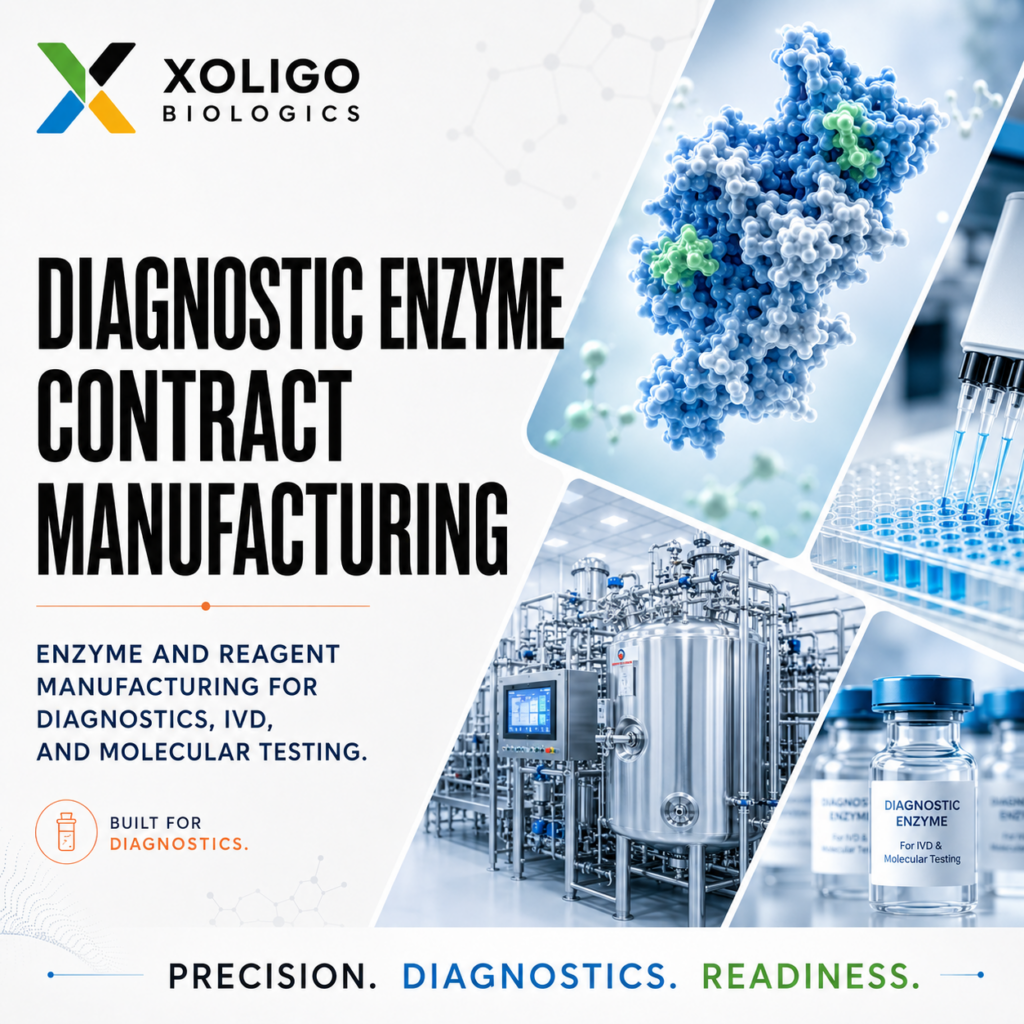
Our work connects recombinant protein expression, enzyme manufacturing, microbial fermentation, oligonucleotide development, analytical characterization, formulation support, reagent stabilization, and pre-GMP or commercial transfer planning.
From Cambridge, we support assay strategy, biotech interface, and customer program design. From Montreal, we support nucleic acid development, analytical characterization, and manufacturing-pathway planning. From Frederick, Maryland, we support recombinant enzyme production, microbial fermentation, diagnostic reagent manufacturing, assay-ready proteins, and component development.
The objective is simple: help diagnostic and life science companies manufacture enzyme and reagent components that are reliable enough to build real products around.
The Component Layer Behind Diagnostics
Diagnostics are often described through their final format: qPCR kits, lateral flow assays, biosensors, sequencing workflows, immunoassays, CRISPR diagnostics, companion diagnostics, enzymatic assays, clinical chemistry reagents, or molecular testing platforms.
But underneath every format is a component layer.
That layer includes enzymes, proteins, oligos, substrates, controls, standards, buffers, stabilizers, and documentation. These components determine whether the assay is sensitive, specific, reproducible, stable, scalable, and manufacturable.
Xoligo focuses on this layer.
We support customers who need custom or contract manufacturing for diagnostic enzymes and assay components, including:
DNA polymerases
RNA polymerases
Reverse transcriptases
Ligases
Nucleases
Restriction enzymes
RNase inhibitors
Proteases
Dehydrogenases
Oxidases
Peroxidases
Phosphatases
Recombinant antigens
Assay-ready proteins
Controls and calibrators
Enzyme-compatible oligonucleotide systems
Custom reagent and kit components
Some customers need one enzyme. Others need a full reagent system. Some need research-scale material for assay development. Others need repeatable manufacturing for commercial diagnostic products.
Xoligo can support the full development logic from early feasibility to transfer-ready production.
Recombinant Enzyme Production for IVD and Molecular Diagnostics
Diagnostic enzymes must do more than express well.
They must perform inside a specific assay environment.
That means the manufacturing process must consider activity, purity, specificity, stability, residual impurities, storage conditions, buffer compatibility, formulation, and lot-to-lot reproducibility.
Xoligo supports recombinant enzyme production for molecular diagnostics, IVD reagents, amplification systems, detection platforms, biosensors, and clinical research tools.
Programs may include:
Gene synthesis and construct design
Codon optimization
Expression system selection
E. coli expression
Yeast or Pichia expression
Mammalian expression where appropriate
Fermentation development
Cell lysis and clarification
Purification process development
Activity testing
Stability screening
Formulation support
Documentation and batch records
Scale-up and transfer support
For many diagnostic enzymes, microbial expression is the most practical path. E. coli and yeast systems can support efficient production, attractive cost structures, and scalable manufacturing. For more complex enzymes or proteins requiring specific folding or processing, alternative hosts may be considered.
The correct platform depends on the molecule, the assay, the customer’s quality expectations, and the long-term manufacturing path.
Polymerases, Reverse Transcriptases, and Amplification Enzymes
Molecular diagnostics depend heavily on enzyme performance.
qPCR, RT-qPCR, isothermal amplification, sequencing workflows, genotyping, pathogen detection, oncology assays, and RNA testing all rely on polymerases, reverse transcriptases, and related enzymes that must remain active, specific, and stable.
Xoligo supports production and development of amplification-related enzymes, including DNA polymerases, RNA polymerases, reverse transcriptases, strand-displacement enzymes, and customer-specific variants.
For diagnostic customers, enzyme manufacturing is not only about activity. It is about reproducibility.
A polymerase may need to tolerate inhibitors. A reverse transcriptase may need to perform across difficult RNA templates. A hot-start system may need specific activation behavior. An isothermal enzyme may need strong activity at defined temperatures. A sequencing enzyme may need consistency across complex sample types.
These requirements influence expression, purification, formulation, and analytical testing.
Xoligo helps customers align the manufacturing process with the diagostic function rather than treating enzyme production as an isolated supply task.
CRISPR Diagnostic Enzyme Manufacturing
CRISPR diagnostics are creating new demand for Cas enzymes and associated molecular components.
Cas12 and Cas13 systems, in particular, are used in detection platforms where enzyme activity, guide compatibility, collateral cleavage behavior, stability, and purity all influence assay performance.
Xoligo supports CRISPR diagnostic enzyme manufacturing for companies developing next-generation molecular diagnostics, infectious disease assays, companion diagnostics, field-deployable testing platforms, and research-use detection systems.
Our support may include:
Cas12 enzyme production
Cas13 enzyme production
Guide RNA compatibility evaluation
Reporter system compatibility
Low-endotoxin production
Activity assay support
Stability screening
Formulation development
Diagnostic reagent integration
Scale-up and documentation
This connects directly to Xoligo’s broader CRISPR Enzyme Production and Oligonucleotide Development services. The enzyme and guide RNA should not be developed in isolation. They must be understood together as an assay system.
That is where Xoligo’s component CDMO model creates value.
Enzymes for Clinical Chemistry, Biosensors, and Reagent Systems
Not all diagnostic enzyme manufacturing is nucleic-acid based.
Many clinical chemistry, biosensor, metabolic, industrial, and research-tool applications depend on enzymes that generate measurable signals, convert substrates, support detection, or stabilize assay workflows.
Xoligo supports recombinant enzyme and assay-protein manufacturing for these applications, including oxidases, dehydrogenases, peroxidases, phosphatases, proteases, and other custom enzymes.
These programs often require a practical manufacturing mindset.
The enzyme must be active. It must be stable. It must be compatible with buffers, substrates, stabilizers, conjugation methods, packaging formats, and commercial use conditions. It may need to withstand lyophilization, drying, immobilization, or long-term storage.
A technically elegant enzyme is not enough if it fails inside the product.
Xoligo focuses on functional manufacturing: making enzymes that work in the customer’s real diagnostic or reagent environment.
Assay-Ready Proteins, Antigens, Controls, and Calibrators
Diagnostic products often require more than enzymes.
They need antigens, receptors, binding proteins, antibody fragments, calibrators, standards, positive controls, negative controls, and matrix-compatible materials.
Xoligo supports assay-ready recombinant proteins and diagnostic components that can be used in immunoassays, molecular assays, functional assays, companion diagnostics, quality-control products, and research kits.
Capabilities may include:
Recombinant antigen production
Control protein production
Calibrator material development
Cytokines and receptor proteins
Antibody fragment support
Enzyme-linked proteins
Assay standards
Reference materials
Protein-oligo system components
Custom reagent components
This is especially important for diagnostic developers that do not want to manage separate vendors for enzymes, oligos, proteins, standards, and analytical support.
Xoligo can help consolidate the component-development layer so customers can focus on assay performance and commercialization.
Oligonucleotide and Enzyme System Integration
Many diagnostic systems depend on both enzymes and oligonucleotides.
Primers, probes, guide RNAs, reporters, molecular standards, synthetic controls, and amplification components must be designed around enzyme behavior. The enzyme must perform with the oligo set, and the oligo set must be compatible with the enzyme.
This is one of Xoligo’s strongest strategic advantages.
Because we support both oligonucleotide development and enzyme manufacturing, we can help customers think through the complete assay component system.
That may include:
Primer and probe compatibility
qPCR and RT-qPCR components
Guide RNA and Cas enzyme compatibility
Reporter oligo systems
Synthetic RNA controls
Molecular standards
Enzyme-compatible buffer systems
Assay optimization support
Stability and storage planning
The best diagnostic products are not built from isolated parts. They are built from components that have been developed to work together.
Xoligo is designed for that.
Fermentation and Scale-Up
Diagnostic enzyme programs frequently need a different commercial logic than therapeutic programs.
Therapeutics may emphasize clinical progression and regulatory development. Diagnostic and reagent programs often emphasize cost, repeatability, activity, supply continuity, shelf life, and batch-to-batch consistency.
Xoligo’s fermentation and scale-up support is designed around those needs.
For microbial enzyme production, we can support expression screening, fermentation optimization, induction strategy, harvest development, purification, endotoxin reduction, formulation, and scale-up planning.
As programs mature, we help customers identify the practical manufacturing path: research supply, pilot production, commercial reagent supply, pre-GMP material, or transfer to a larger manufacturing partner.
The goal is not to overbuild too early. The goal is to design a process that can grow without falling apart.
Purification and Impurity Control
Diagnostic enzymes require careful purification because impurities can directly affect assay performance.
Host cell proteins, host cell DNA, nucleases, proteases, endotoxin, aggregates, residual media components, or unwanted enzymatic activity can all create problems. In molecular diagnostics, nuclease contamination is especially dangerous because it can damage nucleic acid components or alter assay results.
Xoligo develops purification processes with the final use in mind.
Purification strategies may include affinity capture, ion exchange, hydrophobic interaction, size exclusion, polishing steps, endotoxin reduction, concentration optimization, filtration, and buffer exchange.
Analytical support may include purity assessment, identity confirmation, activity testing, residual impurity analysis, nuclease testing, endotoxin evaluation, protein concentration, stability testing, and lot comparison.
For diagnostic products, purity is not only a number on a certificate. It is a performance variable.
Stability, Formulation, and Lyophilization Support
Many diagnostic enzymes must remain stable during storage, shipping, kit assembly, and customer use.
That creates a need for formulation and stabilization support.
Xoligo can support buffer screening, stabilizer evaluation, storage-condition studies, freeze-thaw testing, activity retention analysis, lyophilization support, and compatibility studies with assay components.
This is especially relevant for companies developing field-deployable diagnostics, point-of-care systems, dried reagents, kit components, or products that require extended shelf life.
A diagnostic enzyme should not merely perform on the day it is purified.
It should perform when the customer actually uses it.
Documentation and Quality Support
Diagnostic manufacturing requires discipline.
Even when a project is not yet under full GMP or IVD regulatory control, customers often need documentation that supports internal QA, customer qualification, supplier review, technical transfer, validation, and future regulatory planning.
Xoligo can provide documentation packages appropriate to the development stage, including batch summaries, analytical reports, certificates of analysis, process summaries, material specifications, stability data, method notes, and transfer packages.
The level of documentation can be adapted to the customer’s use case: research, RUO, preclinical, diagnostic development, IVD component supply, or manufacturing transfer.
This gives customers stronger control over their component supply chain without forcing every early-stage project into a full commercial quality system before it is ready.
Why Xoligo for Diagnostic Enzyme Manufacturing
Xoligo is different because we understand both sides of the diagnostic component problem.
We understand recombinant protein and enzyme production.
We also understand oligonucleotides, RNA workflows, CRISPR systems, microbial fermentation, analytical characterization, reagent stabilization, and diagnostic component manufacturing.
That combination matters.
A company making a molecular diagnostic may need polymerases, primers, probes, RNA controls, plasmids, enzymes, standards, and stability support. A company developing a CRISPR diagnostic may need Cas enzymes, guide RNAs, reporter systems, activity assays, and reagent stabilization. A clinical chemistry company may need custom enzymes, calibrators, controls, and repeatable contract manufacturing.
Xoligo brings those pieces into one development philosophy.
Our role is not just to produce a protein.
Our role is to help make the diagnostic system work.
Top 70 FAQ: Diagnostic Enzyme Contract Manufacturing
1. What does Xoligo mean by diagnostic enzyme contract manufacturing?
Diagnostic enzyme contract manufacturing means the development, expression, purification, characterization, stabilization, and supply support of enzymes used in diagnostic assays, IVD systems, molecular testing workflows, biosensors, clinical reagents, and kit components. Xoligo supports the enzyme as part of the complete diagnostic system, not only as an isolated recombinant protein.
2. What types of diagnostic enzymes can Xoligo support?
Xoligo can support polymerases, reverse transcriptases, ligases, nucleases, restriction enzymes, nicking enzymes, Cas enzymes, oxidases, dehydrogenases, peroxidases, phosphatases, pyrophosphatases, RNase inhibitors, DNases, proteases, and custom catalytic proteins used in diagnostic or molecular testing workflows.
3. Does Xoligo support molecular diagnostic enzyme manufacturing?
Yes. Xoligo supports enzymes used in qPCR, RT-qPCR, ddPCR, isothermal amplification, NGS workflows, CRISPR diagnostics, sample preparation, nucleic acid cleanup, and target detection. These programs may include enzyme production, oligo compatibility, activity assays, impurity testing, stabilization, and transfer documentation.
4. Can Xoligo manufacture enzymes for IVD kit components?
Yes. Xoligo can support IVD-adjacent enzyme and reagent component manufacturing, including diagnostic enzymes, controls, calibrators, antigens, RNA controls, oligo reagents, assay proteins, and stabilized or lyophilization-ready components. The exact quality pathway depends on the program stage, regulatory plan, and intended market.
5. How is Xoligo different from a catalogue enzyme supplier?
A catalogue supplier provides standard reagents. Xoligo supports custom and development-stage enzyme programs where the enzyme must fit a specific assay, diagnostic system, stability requirement, impurity profile, transfer package, or pre-GMP pathway. Xoligo can help tune the enzyme around the customer’s actual diagnostic use case.
6. Can Xoligo develop custom enzymes for proprietary diagnostic platforms?
Yes. Xoligo can support custom recombinant enzyme development for proprietary assays, molecular diagnostic platforms, biosensors, CRISPR detection systems, sample preparation workflows, and specialized reagent products. Support can include construct strategy, host selection, expression screening, purification, activity testing, stabilization, and documentation.
7. Does Xoligo support CRISPR diagnostic enzyme manufacturing?
Yes. Xoligo can support Cas12, Cas13, Cas9-derived, dCas, nickase, engineered nuclease, and CRISPR-adjacent enzyme components for diagnostic applications. These projects may also include guide RNA development, reporter oligos, target controls, matched reference materials, activity assays, and stability support.
8. Can Xoligo help with enzymes for isothermal amplification?
Yes. Xoligo can support enzyme components used in isothermal amplification systems, including polymerases, reverse transcriptases, strand-displacement enzymes, nicking enzymes, ligases, and accessory proteins. Development can include expression, purification, assay-context activity testing, formulation screening, and lot-to-lot comparability.
9. Can Xoligo support clinical chemistry enzyme components?
Yes. Xoligo can support diagnostic enzymes used in clinical chemistry and biosensor formats, including oxidases, dehydrogenases, peroxidases, phosphatases, and related enzyme systems. These programs may focus on activity, substrate compatibility, reagent stability, matrix tolerance, calibration, and scalable supply.
10. What expression systems can Xoligo use for diagnostic enzymes?
Depending on the enzyme, Xoligo may support E. coli, yeast/Pichia, mammalian, or partner-supported expression systems. Host selection depends on folding, solubility, secretion, activity, impurity burden, endotoxin risk, glycosylation relevance, purification needs, and final assay format.
11. Can Xoligo help choose between E. coli and Pichia for a diagnostic enzyme?
Yes. E. coli may be best for fast, scalable production of many enzymes, but Pichia or yeast may be useful when secretion, folding, disulfide handling, or improved downstream behavior matters. Xoligo evaluates the enzyme’s function, expression risk, purification path, impurity concerns, and diagnostic use case before selecting a platform.
12. Does Xoligo provide low-endotoxin diagnostic enzyme production?
Xoligo can support endotoxin reduction strategy and testing for E. coli-derived diagnostic enzymes, especially when the enzyme will be used in cell-based assays, sensitive molecular workflows, or pre-GMP development. The endotoxin target should match the intended use rather than being arbitrarily overbuilt.
13. Can Xoligo test residual host cell DNA and host cell protein in diagnostic enzymes?
Yes. Xoligo can support residual host cell DNA and host cell protein testing for diagnostic enzyme lots. This is especially relevant when host-derived impurities may affect assay background, amplification, stability, lot consistency, or future transfer.
14. Does Xoligo support nuclease contamination testing?
Yes. For RNA workflows, molecular diagnostics, and nucleic acid-sensitive assays, contaminating nuclease activity can create major problems. Xoligo can support nuclease-risk evaluation and functional testing to determine whether an enzyme preparation may damage RNA, DNA, probes, primers, controls, or diagnostic targets.
15. Can Xoligo help stabilize diagnostic enzymes for kits?
Yes. Xoligo supports stabilization and lyophilization-readiness for diagnostic enzymes. This may include buffer screening, excipient evaluation, freeze-thaw testing, accelerated stability, activity retention, reconstitution performance, and compatibility with final kit conditions.
16. Can Xoligo develop lyophilized diagnostic enzyme reagents?
Xoligo can support lyophilization strategy and development support for diagnostic enzyme components, including pre-lyophilization formulation review, post-lyophilization activity testing, storage studies, and kit-readiness evaluation. Some lyophilization work may be conducted internally or through appropriate partners depending on the program.
17. Can Xoligo manufacture matched enzyme and oligo diagnostic systems?
Yes. This is one of Xoligo’s stronger hybrid service areas. Xoligo can support matched diagnostic systems involving an enzyme, primers, probes, guide RNAs, reporter oligos, RNA controls, plasmid controls, standards, calibrators, or protein components. This reduces the risk of developing isolated reagents that do not perform well together.
18. Does Xoligo support diagnostic enzyme activity assay development?
Yes. Xoligo can support activity assay development for diagnostic enzymes, including catalytic activity, amplification performance, substrate conversion, reporter generation, RNA compatibility, CRISPR cleavage activity, or assay-format-specific performance. The goal is to test the enzyme in a way that reflects the final diagnostic use.
19. Can Xoligo compare diagnostic enzyme lots?
Yes. Xoligo can support lot comparability for diagnostic enzymes by evaluating purity, identity, activity, stability, residual impurities, endotoxin, bioburden, assay performance, and storage behavior. This is useful when scaling, changing suppliers, qualifying a new process, or preparing for transfer.
20. Can Xoligo support diagnostic enzyme tech transfer?
Yes. Xoligo can prepare transfer-ready packages that may include construct information, host system, fermentation notes, purification process, analytical data, activity data, impurity profile, stability summary, storage recommendations, batch history, and manufacturing recommendations.
21. Can Xoligo help if a diagnostic enzyme works at bench scale but fails in the final assay?
Yes. Xoligo can help troubleshoot whether the issue is enzyme activity, buffer incompatibility, impurity burden, nuclease contamination, oligo design, reporter chemistry, protein instability, lyophilization stress, matrix interference, or assay architecture. Diagnostic enzyme failure is often a system problem, not just an enzyme problem.
22. Can Xoligo support enzymes for biosensors and point-of-care testing?
Yes. Xoligo can support enzyme components for biosensors and point-of-care diagnostic systems, including enzymes that generate measurable electrochemical, colorimetric, fluorescent, or molecular signals. These projects often require stability, substrate compatibility, surface compatibility, reproducibility, and formulation support.
23. Does Xoligo support enzyme-plus-control packages for diagnostic developers?
Yes. Xoligo can support enzyme-plus-control packages that include the diagnostic enzyme, positive controls, negative controls, calibrators, standards, RNA controls, DNA controls, plasmid controls, or reporter materials. This is useful for assay development, validation planning, customer sampling, and transfer.
24. Can Xoligo support weird or niche hybrid diagnostic reagent systems?
Yes. Xoligo is built for niche hybrid component systems. Examples include Cas enzyme plus guide RNA plus reporter oligo packages, antibody-oligo diagnostic conjugates, enzyme-linked molecular controls, RNA standard and enzyme compatibility packages, protein calibrator plus oligo readout systems, biosensor enzyme components, and matched reagent sets for unusual assay architectures.
25. What is the most advanced diagnostic enzyme manufacturing use case Xoligo can support?
One advanced use case is a complete CRISPR or molecular diagnostic component system: custom Cas enzyme or polymerase, guide RNA or primers, reporter oligos, RNA or DNA target controls, recombinant protein standards, positive and negative controls, activity assays, residual impurity testing, endotoxin and bioburden awareness, stabilization, lyophilization-readiness, lot comparability, and a transfer-ready CMC package. In this model, Xoligo supports not just the enzyme, but the functional diagnostic reagent ecosystem around it.
26. Can Xoligo support beta-hydroxybutyrate dehydrogenase manufacturing?
Yes. Xoligo can support development and manufacturing support for beta-hydroxybutyrate dehydrogenase, also called BHB dehydrogenase, for diagnostic reagent systems. BHB dehydrogenase is commonly relevant to ketone testing, metabolic assays, clinical chemistry workflows, and reagent systems where reliable enzyme activity and lot consistency matter. Xoligo can support expression strategy, fermentation planning, purification, activity testing, stability evaluation, and transfer-ready documentation for BHB dehydrogenase programs.
27. Can Xoligo help develop salicylate hydroxylase for diagnostic applications?
Yes. Xoligo can support salicylate hydroxylase development for diagnostic and clinical chemistry applications where salicylate detection, enzyme specificity, reagent stability, and assay performance are important. Support may include recombinant expression, microbial fermentation, purification, activity assay development, substrate compatibility testing, formulation screening, and lot comparability. This type of program is well suited to Xoligo’s enzyme-plus-diagnostic-reagent model.
28. Can Xoligo support uricase enzyme manufacturing?
Yes. Xoligo can support uricase development and manufacturing support for diagnostic reagent systems, uric acid assays, clinical chemistry workflows, biosensor systems, and research-use enzyme platforms. Uricase programs may require attention to activity, stability, oxygen dependence, peroxide-generating assay systems, formulation compatibility, and lot-to-lot reproducibility. Xoligo can help produce and characterize uricase as a functional diagnostic component.
29. Can Xoligo manufacture phenylalanine dehydrogenase?
Yes. Xoligo can support phenylalanine dehydrogenase development for diagnostic, metabolic, enzymatic assay, and clinical chemistry applications. These programs may require recombinant expression, fermentation, purification, cofactor-aware activity testing, substrate-specificity evaluation, stability studies, and transfer documentation. Xoligo can help customers develop phenylalanine dehydrogenase as part of a broader reagent or assay system.
30. Can Xoligo support diaphorase production?
Yes. Xoligo can support diaphorase enzyme development and manufacturing support for diagnostic reagents, redox-linked assays, clinical chemistry systems, biosensors, and colorimetric or electrochemical detection workflows. Diaphorase may be used in coupled enzyme systems where electron transfer, substrate compatibility, cofactor cycling, and reagent stability are critical. Xoligo can support expression, purification, activity testing, formulation, and comparability.
31. Can Xoligo support oxidase enzyme manufacturing for clinical chemistry assays?
Yes. Xoligo can support oxidase enzyme programs for diagnostic and reagent applications, including glucose oxidase-adjacent systems, cholesterol oxidase-adjacent systems, lactate oxidase-adjacent systems, urate oxidase, and other oxidase-based detection workflows. These programs often require activity retention, substrate specificity, oxygen and peroxide-system compatibility, stabilization, and lot consistency. Xoligo can help develop oxidases as assay-ready enzyme components.
32. Can Xoligo support dehydrogenase enzyme manufacturing beyond BHB and phenylalanine dehydrogenase?
Yes. Xoligo can support broader dehydrogenase enzyme development for clinical chemistry, metabolic testing, biosensors, and coupled assay systems. Dehydrogenases often require careful cofactor compatibility, activity testing, substrate-specificity work, formulation evaluation, and stability support. Xoligo can help customers evaluate expression host, fermentation route, purification strategy, and diagnostic assay fit for custom dehydrogenase programs.
33. Can Xoligo support peroxidase and colorimetric enzyme systems?
Yes. Xoligo can support peroxidase-related enzyme systems and colorimetric diagnostic workflows where enzyme activity produces a measurable signal. These programs may involve enzyme production, substrate compatibility, coupled-reaction optimization, stabilizer screening, background reduction, and kit-readiness planning. Xoligo can also help evaluate whether impurities, buffer conditions, or storage stress are affecting assay signal.
34. Can Xoligo support coupled enzyme systems for diagnostics?
Yes. Xoligo can support coupled enzyme systems where one enzyme generates a product that another enzyme detects, converts, amplifies, or reports. This is common in clinical chemistry, metabolic testing, biosensors, and colorimetric assays. Xoligo can help develop each enzyme component and evaluate the full functional system, including activity balance, reaction timing, cofactor compatibility, signal strength, background, and stability.
35. Can Xoligo support enzyme manufacturing for ketone diagnostic reagents?
Yes. Xoligo can support enzyme components for ketone testing workflows, including BHB dehydrogenase-related reagent systems. These programs may require enzyme activity testing, cofactor compatibility, reagent formulation, stability support, calibrator development, control material planning, and transfer-ready documentation. Xoligo can help build the enzyme and supporting reagent system around the intended diagnostic assay.
36. Can Xoligo support enzyme manufacturing for uric acid testing?
Yes. Xoligo can support uricase and related enzyme reagent systems for uric acid testing, clinical chemistry, biosensors, and metabolic assays. Support may include recombinant enzyme production, purification, activity testing, peroxide-linked assay compatibility, stabilization, lot comparability, and reference material support. Xoligo can also help develop controls and calibrators around the uric acid assay workflow.
37. Can Xoligo support enzyme manufacturing for salicylate testing?
Yes. Xoligo can support salicylate hydroxylase and related enzyme systems for salicylate assay development, toxicology-related testing, clinical chemistry workflows, and diagnostic reagent manufacturing. These programs may require substrate specificity evaluation, activity assays, enzyme stability, buffer compatibility, cofactor considerations, and lot-to-lot reproducibility.
38. Can Xoligo support metabolic enzyme reagent systems?
Yes. Xoligo can support metabolic enzyme reagents used in clinical chemistry, biosensors, research-use assays, and diagnostic development. This may include dehydrogenases, oxidases, hydroxylases, reductases, transferases, phosphatases, and coupled enzyme systems. Xoligo can support both the individual enzyme component and the broader assay architecture, including controls, calibrators, stabilizers, and documentation.
39. Can Xoligo support commercial-scale diagnostic enzyme supply?
Yes. Xoligo can support programs moving from early development and validation lots toward recurring commercial supply planning. Depending on the enzyme and quality expectations, support may include scalable fermentation, purification development, activity testing, stability studies, lot comparability, supply documentation, and transfer to an appropriate long-term manufacturing pathway.
40. Can Xoligo support validation lots before commercial reagent supply?
Yes. Xoligo can support validation, pilot, engineering, feasibility, pre-GMP, and bridge lots for diagnostic enzymes and reagent components. These lots help customers evaluate activity, stability, formulation, assay performance, customer sampling, supplier qualification, and manufacturing transfer before committing to larger recurring production.
41. Can Xoligo support U.S.-based precision fermentation for diagnostic enzymes?
Yes. Xoligo can support U.S.-aligned precision fermentation strategies for diagnostic enzyme and recombinant reagent programs, especially where customers want domestic development, clearer communication, tighter supply-chain oversight, or transfer-ready documentation. Programs may involve E. coli, yeast, Pichia, or other appropriate expression systems depending on the enzyme and intended diagnostic use.
42. Can Xoligo support ISO-style documentation for diagnostic enzyme programs?
Yes. Xoligo can support documentation packages that align with quality-minded diagnostic development, including batch summaries, process descriptions, specifications, certificates of analysis, activity data, purity data, impurity testing, stability summaries, storage recommendations, and transfer notes. The package can be right-sized for research, pre-GMP, IVD-adjacent, or commercial supply planning.
43. Can Xoligo support GMP-pathway planning for diagnostic enzyme manufacturing?
Yes. Xoligo can support GMP-pathway and quality-pathway planning for diagnostic enzyme programs. Not every diagnostic reagent requires the same quality framework, but many need defined process controls, repeatability, lot traceability, activity assays, impurity awareness, stability data, and documentation suitable for transfer or regulated product development.
44. Can Xoligo support FDA-facing or IVD-pathway reagent documentation?
Xoligo can support development documentation useful for FDA-facing, IVD-pathway, partner-facing, or quality-team review. This may include process history, lot data, activity assays, stability information, impurity testing, control strategies, material specifications, and transfer packages. Regulatory claims and final submission strategy should be handled with appropriate regulatory specialists, but Xoligo can help build the technical material foundation.
45. Can Xoligo support enzyme reagent systems for automated clinical chemistry analyzers?
Yes. Xoligo can support enzyme components and reagent systems intended for automated clinical chemistry workflows, depending on the assay architecture. These programs may require attention to enzyme activity, liquid reagent stability, calibrator compatibility, open-vial stability, interference, signal linearity, substrate behavior, and lot-to-lot consistency.
46. Can Xoligo support liquid bulk diagnostic reagent manufacturing?
Yes. Xoligo can support liquid bulk reagent development and manufacturing support for diagnostic enzymes, buffers, controls, calibrators, molecular reagents, and clinical chemistry components. This may include formulation screening, stability evaluation, bioburden awareness, component compatibility, storage-condition planning, and transfer documentation.
47. Can Xoligo support dry or lyophilized diagnostic enzyme reagents?
Yes. Xoligo can support lyophilization-readiness and dry reagent development for diagnostic enzymes and reagent systems. This may include excipient screening, freeze-thaw evaluation, post-reconstitution activity testing, moisture-related stability review, accelerated stability, real-time stability, and assay performance after drying.
48. Can Xoligo support enzyme reagents for biosensors and electrochemical diagnostics?
Yes. Xoligo can support enzyme components used in biosensors, electrochemical diagnostics, wearable-style testing concepts, and surface-linked assay formats. These programs may involve oxidases, dehydrogenases, diaphorase systems, redox-linked enzymes, stabilization, substrate compatibility, immobilization compatibility, and activity retention after surface or formulation exposure.
49. Can Xoligo help replace an existing diagnostic enzyme supplier?
Yes. Xoligo can support supplier-replacement and second-source programs for diagnostic enzymes. This may include reverse-scoping the required enzyme attributes, comparing activity and stability, developing a new expression and purification process, evaluating lot comparability, testing assay performance, and generating transfer documentation. The goal is not simply to copy a supplier, but to build a reliable alternative supply route.
50. Can Xoligo develop a complete clinical chemistry enzyme reagent package?
Yes. Xoligo can support complete enzyme reagent packages for clinical chemistry and molecular diagnostics, including recombinant enzyme production, cofactor and substrate compatibility, stabilizer screening, controls, calibrators, activity assays, residual impurity testing, bioburden awareness, liquid or lyophilized formulation support, lot comparability, and transfer-ready documentation.
51. We currently use beta-hydroxybutyrate dehydrogenase from another supplier. Can Xoligo reproduce or improve our existing workflow?
In many cases, that’s exactly how projects begin. Rather than forcing a redesign of the assay, Xoligo typically starts by understanding the existing reagent, its performance characteristics, and where limitations exist. Some clients simply need a reliable second source; others want higher activity, improved stability, or a manufacturing process that is easier to scale.
52. Which expression system usually performs best for diagnostic enzymes?
There is rarely one universal answer. Small cytosolic enzymes often perform extremely well in E. coli, while secreted proteins or enzymes requiring more complex folding may benefit from Pichia or mammalian expression. Host selection is driven by the biology of the enzyme rather than by habit.
53. My assay already works. Why would I redesign the enzyme?
Sometimes you shouldn’t.
Many programs simply need manufacturing continuity or better supply security. Others discover that modest improvements in purity, aggregation profile, storage stability, or formulation dramatically improve assay robustness without changing the assay itself.
54. Can one enzyme be optimized for several different diagnostic kits?
Occasionally, but not always.
An enzyme performing perfectly in a clinical chemistry analyzer may behave differently inside a PCR reagent, biosensor, lateral flow device, or lyophilized kit. The surrounding chemistry often matters as much as the enzyme itself.
55. What usually causes the biggest delays in enzyme development?
It is often not expression.
Unexpected purification behavior, formulation compatibility, stability problems, or analytical characterization frequently consume more time than producing the recombinant protein itself.
56. Why do some enzyme projects succeed immediately while others become difficult?
Different proteins behave differently.
Two enzymes with similar molecular weights may require completely different expression hosts, purification strategies, cofactors, or stabilization approaches. Predicting those differences early is one of the reasons specialist development teams exist.
57. Could Xoligo manufacture enzymes that never become commercial products?
Absolutely.
Many enzymes are produced only to support internal R&D, validation studies, feasibility work, assay optimization, or technology demonstrations. Commercial launch is only one possible outcome.
58. We only require a few grams each year. Is that too small?
Not necessarily.
Many diagnostic enzyme programs fall into exactly that range. Small-volume, high-value manufacturing is often a better fit than extremely large commodity production.
59. How early should an enzyme manufacturer become involved?
Earlier than most companies expect.
Small decisions made during construct design or early expression screening often determine whether future scale-up becomes straightforward or frustrating.
60. Can manufacturing actually improve assay performance?
It often can.
Changes in purification strategy, endotoxin burden, aggregation, formulation, storage conditions, or batch consistency may improve reproducibility without altering the biology of the assay itself.
61. Does every diagnostic enzyme require GMP production?
No.
Research-use material, feasibility studies, validation lots, pre-GMP bridge material, and commercial IVD manufacturing all have different expectations. Matching the manufacturing strategy to the development stage is usually more valuable than overbuilding quality systems too early.
62. Can fermentation strategy affect diagnostic performance?
Indirectly, yes.
Expression conditions influence folding, impurity profiles, post-expression processing, and ultimately the behavior of the purified enzyme inside the assay.
63. Why do some clients request a second supplier even when their current one works?
Risk management.
Supply interruptions, acquisitions, pricing changes, geographic concentration, or future scale requirements often justify qualifying an alternative manufacturing partner before a problem appears.
64. Can Xoligo help modernize an older diagnostic reagent?
That is becoming increasingly common.
Many established diagnostic products were designed decades ago. Updating expression systems, purification methods, documentation, or stability programs can often extend the commercial life of a successful assay.
65. Are enzymes the only critical component in diagnostic manufacturing?
Usually not.
Controls, calibrators, buffers, recombinant proteins, oligonucleotides, transport media, and formulation chemistry frequently contribute just as much to overall assay performance.
66. What kinds of diagnostic companies typically approach Xoligo?
Everything from early biotech startups with a single enzyme concept to established diagnostic manufacturers looking for manufacturing support, supply diversification, or next-generation reagent development.
67. Is there value in redesigning a manufacturing process without changing the enzyme sequence?
Quite often.
Manufacturing improvements alone may increase yield, simplify purification, improve storage, reduce impurities, or make future scale-up more predictable.
68. Why does Xoligo focus so heavily on components instead of complete finished kits?
Because components usually determine whether the finished kit succeeds.
Reliable enzymes, proteins, oligonucleotides, standards, and controls create reliable diagnostics.
69. What projects are the best fit for Xoligo?
The ones sitting in the gap between research and commercial manufacturing—where scientific uncertainty still exists, but the program needs engineering discipline to move forward.
70. What is the long-term goal of Xoligo’s diagnostic enzyme platform?
To become the specialist partner companies call when they need the biological components behind diagnostics—not just another enzyme supplier, but a development organization that understands proteins, nucleic acids, fermentation, analytics, and manufacturing as one connected system.
Building Better Diagnostic Components
Diagnostics are becoming more molecular, more decentralized, more automated, more data-driven, and more dependent on specialized biological components.
That creates opportunity, but it also creates complexity.
Companies need partners who can manufacture enzymes, oligos, proteins, controls, and reagent systems with enough technical depth to support real commercialization.
Xoligo Biologics was built for that layer.
Whether you are developing a qPCR kit, CRISPR diagnostic, biosensor, companion diagnostic, molecular reagent system, clinical research assay, or custom IVD component, Xoligo can help develop and manufacture the enzyme and protein components behind the product.
Because diagnostic performance is not created at the final assay step.
It is built into every component from the beginning.