
Oligonucleotide, RNA, CRISPR, Protein, Enzyme, and Diagnostic Component Modalities
Modern biotechnology is no longer organized around one molecule type.
The strongest genetic medicine, diagnostic, CRISPR, RNA, and precision biomanufacturing programs depend on a connected set of modalities: oligonucleotides, modified strands, mRNA, guide RNA, self-amplifying RNA, circular RNA, aptamers, recombinant enzymes, Cas proteins, diagnostic primers and probes, protein-oligo conjugates, nucleic acid standards, controls, calibrators, and assay-ready biological components.
A therapeutic modality may begin as a strand, but it rarely stays isolated. An ASO needs modification strategy, impurity profiling, stability data, and analytical support. An siRNA may need duplex evaluation, conjugation planning, formulation compatibility, and controls. An mRNA program needs plasmid template logic, IVT enzymes, RNA integrity analysis, residual impurity testing, LNP-readiness, and CMC documentation. A CRISPR program needs Cas protein, guide RNA, reporter systems, controls, activity assays, and comparability. A diagnostic modality may require primers, probes, enzymes, antigens, RNA controls, calibrators, and stabilized reagent systems.
That is why Xoligo Biologics organizes its work around modalities as well as services.
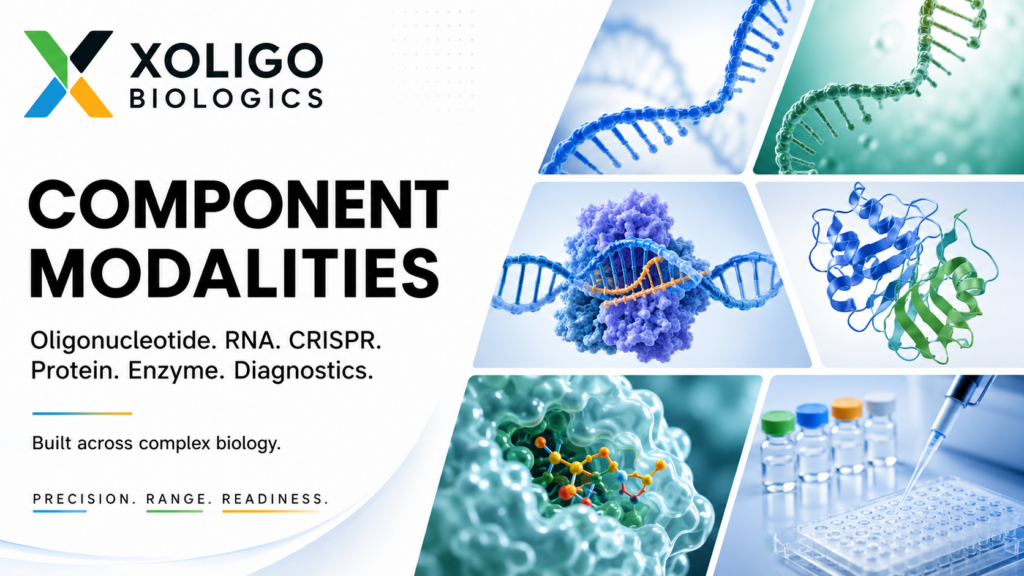
Xoligo is a Component CDMO for genetic medicine, diagnostics, RNA workflows, CRISPR systems, recombinant enzymes, and precision biomanufacturing. We help customers develop the component layer behind modern platforms: strands, RNA, proteins, enzymes, diagnostic materials, assay reagents, reference standards, stability programs, analytical packages, and transfer-ready documentation.
The goal is not only to make a molecule.
The goal is to make the right modality work inside the system where it matters.
From Cambridge, Xoligo supports modality strategy, scientific planning, customer intake, and development-roadmap design. From Montreal, we support nucleic acid development, oligonucleotide characterization, RNA workflows, and GMP-pathway planning. From Frederick, Maryland, we support recombinant enzymes, microbial fermentation, CRISPR proteins, diagnostic reagents, assay-ready proteins, and pre-GMP biological component development.
Together, these capabilities allow Xoligo to support advanced modalities as functional development programs rather than isolated product categories.
How Xoligo Thinks About Modalities
A modality is not only a technical label.
It defines the development logic of a program.
An ASO behaves differently from an siRNA. A guide RNA behaves differently from an mRNA. A circular RNA creates different analytical questions than a linear transcript. A diagnostic primer-probe set creates different risks than a therapeutic oligo. A Cas enzyme needs different functional testing than a polymerase. A protein-oligo conjugate has different stability problems than either the protein or oligo alone.
Each modality brings its own risks:
sequence design
chemical modification
impurity profile
duplex formation
RNA integrity
enzyme compatibility
residual impurities
functional activity
stability
formulation
assay performance
lot comparability
documentation
transfer pathway
Xoligo’s role is to help customers define the modality-specific development path early enough to avoid wasted work later.
A company may arrive with a sequence, construct, RNA transcript, enzyme, diagnostic reagent, or protein component. Xoligo helps determine what the material needs next: better analytics, a stronger expression route, impurity profiling, stability work, activity testing, pre-GMP bridge material, formulation screening, or transfer documentation.
That is the value of a modality-driven CDMO model.
It recognizes that the molecule type determines the development path.
ASO Development
Antisense oligonucleotides are one of the foundational modalities in genetic medicine.
ASOs are designed to bind RNA targets and modulate splicing, degradation, translation, or other RNA-level mechanisms. Their performance depends on sequence design, chemical modification, backbone strategy, binding behavior, stability, impurity profile, biological activity, and manufacturability.
Xoligo supports ASO development with a component-focused approach. This may include oligonucleotide development, modification review, impurity profiling, analytical characterization, stability support, pre-GMP material planning, comparability, and transfer documentation.
ASO programs often require careful attention to related impurities. Shortmers, longmers, depurination products, incomplete modifications, phosphorothioate-related complexity, degradation fragments, and salt or counterion considerations may all influence quality and development interpretation.
A basic purity number is not always enough.
For early ASO programs, Xoligo can help compare candidate materials, evaluate supplier lots, review analytical data, and prepare stronger development packages. For more advanced programs, Xoligo can support pre-GMP bridge material, stability strategy, impurity awareness, and CMC pathway planning.
ASO development is not just strand production. It is strand understanding.
siRNA Development
siRNA programs require a different development mindset because they involve a duplex system.
The sense strand and antisense strand each have their own sequence, modifications, impurity profile, and stability behavior. Then the duplex introduces additional questions around annealing efficiency, strand ratio, duplex purity, single-stranded carryover, conjugation, formulation, delivery compatibility, and biological performance.
Xoligo supports siRNA development through oligonucleotide component support, impurity profiling, duplex analysis, modification review, stability studies, formulation-readiness, and pre-GMP planning.
For siRNA programs, small chemistry differences can create meaningful biological differences. A truncated antisense strand can affect potency. Duplex instability can affect interpretation. A conjugation difference can alter delivery. Residual single-strand species can complicate assay behavior. Storage conditions can shift performance over time.
Xoligo helps customers evaluate siRNA materials as functional duplex systems, not only as two separate strands.
This is especially useful for companies developing RNAi therapeutics, gene-silencing tools, diagnostic controls, research-use reagents, or conjugated siRNA systems.
miRNA and RNAi Components
miRNA and broader RNAi component development can involve mimics, inhibitors, controls, modified RNA strands, duplexes, standards, assay reagents, and screening materials.
These materials may be used in therapeutic discovery, functional genomics, diagnostic research, gene regulation studies, or platform development.
Xoligo supports miRNA and RNAi components through oligonucleotide development, RNA component characterization, duplex evaluation, control material design, stability support, and analytical testing.
The key issue in RNAi component work is often interpretation. A biological result may depend on sequence design, modification pattern, strand purity, duplex formation, transfection conditions, degradation, or control material quality. Weak or inconsistent RNAi components can make biology look noisy even when the mechanism is valid.
Xoligo helps customers develop RNAi materials that are better understood and easier to compare.
Aptamer Development
Aptamers sit at the intersection of nucleic acids, binding systems, diagnostics, sensors, and targeted recognition.
An aptamer may function as a molecular binder, diagnostic reagent, biosensor component, targeting ligand, analytical tool, or part of a protein-aptamer system. Unlike many simple oligos, aptamers depend heavily on structure, folding, modification, stability, and binding conditions.
Xoligo supports aptamer development by connecting oligonucleotide design, modification strategy, analytical characterization, binding evaluation, protein target support, conjugation-readiness, and stability screening.
For aptamer programs, the target material matters. If the recombinant protein target is poorly folded or impure, aptamer screening or validation can fail. If the aptamer folds incorrectly in the assay buffer, binding may weaken. If conjugation alters structure, performance may decline. If storage conditions degrade the strand, assay results may drift.
Xoligo is useful here because we understand both the nucleic acid side and the protein or diagnostic system around it.
Aptamers are not just sequences. They are folded functional components.
gRNA and sgRNA Development
Guide RNAs are central to CRISPR development.
A guide RNA must be the right sequence, the right length, the right structure, and the right quality for the intended Cas enzyme and application. It may be used for editing, diagnostics, screening, gene regulation, base editing, prime editing, or functional assay development.
Xoligo supports gRNA and sgRNA development through guide RNA design support, oligonucleotide or RNA workflow development, impurity profiling, RNA integrity analysis, Cas compatibility, reporter system integration, and functional assay support.
Guide RNA problems can be difficult to diagnose. A CRISPR workflow may fail because the guide degraded, the Cas protein lost activity, the reporter oligo is weak, the target design is poor, the buffer is incompatible, or residual impurities are interfering with function.
Xoligo treats gRNA development as part of the CRISPR component system.
That includes the guide, the Cas protein, the target, the assay, the reporter, the control material, and the documentation needed for comparability or transfer.
mRNA Development
mRNA development is one of the most important modality areas in genetic medicine.
An mRNA program depends on template design, IVT conditions, polymerase performance, capping strategy, nucleotide chemistry, purification, RNA integrity, residual impurities, formulation compatibility, translation output, stability, and documentation.
Xoligo supports mRNA development through plasmid-to-RNA workflow planning, RNA enzyme manufacturing, RNA integrity and fragment analysis, residual DNA and protein testing, LNP compatibility screening, stability support, pre-GMP bridge material, and CMC package development.
For mRNA, the transcript is only part of the story.
The plasmid template can affect yield and fragment profile. The polymerase can affect productivity and impurity burden. The capping system can affect translation. Purification can improve quality or damage the RNA. Storage can create degradation. Formulation can expose weaknesses that were invisible in simple QC.
Xoligo helps customers evaluate mRNA as a full workflow, not just a final nucleic acid molecule.
This is especially important for teams moving from research-scale RNA toward preclinical studies, formulation work, partner review, or GMP-pathway planning.
Self-Amplifying RNA Development
Self-amplifying RNA creates additional development challenges because it is generally larger, more fragile, and more process-sensitive than many conventional mRNA formats.
saRNA can offer powerful biological potential, but its size and complexity make integrity, purification, stability, and formulation especially important.
Xoligo supports self-amplifying RNA development through template review, RNA workflow support, integrity analysis, fragment monitoring, large-RNA stability studies, enzyme compatibility review, formulation-readiness, and comparability planning.
For saRNA programs, small process stresses can produce large effects. A purification method that works for shorter mRNA may fragment a larger transcript. A storage condition that appears acceptable for one RNA may fail for another. A formulation process may affect integrity, encapsulation, or biological output.
Xoligo helps customers identify these risks early, before the program moves into more expensive development stages.
Circular RNA Development
Circular RNA is a distinct RNA modality with different analytical and process questions.
The development challenge is not only whether RNA was produced. The key question is whether the correct circular form was generated, whether linear precursor remains, whether fragments are present, whether circularization was efficient, and whether the product remains stable.
Xoligo supports circular RNA development through RNA workflow analysis, enzyme and ligation strategy support, circular versus linear species evaluation, fragment analysis, purification planning, stability studies, and functional assessment.
circRNA programs may depend on ligases, ribozymes, template design, structured RNA behavior, and analytical methods capable of distinguishing architecture. A simple RNA purity test may not explain whether the intended modality has been created.
Xoligo approaches circRNA as a system involving RNA sequence, process design, enzymology, analytics, stability, and future transfer.
Modified Oligonucleotides
Modified oligonucleotides are central to therapeutic, diagnostic, research, and platform development.
Modifications may improve nuclease resistance, binding affinity, pharmacology, specificity, delivery, detection, conjugation, or stability. They can also complicate synthesis, purification, analytics, impurity profiling, and comparability.
Xoligo supports modified oligo programs involving backbone modifications, sugar modifications, terminal modifications, labelled oligos, conjugation handles, aptamer modifications, diagnostic probe modifications, guide RNA modifications, and duplex modifications.
Modified oligo development requires more than ordering a strand with changes.
The material must be evaluated for correct incorporation, impurity profile, degradation products, analytical identity, functional performance, and stability. In some cases, modification placement can determine whether the molecule works at all.
Xoligo helps customers understand modified oligos as engineered components rather than decorated sequences.
Diagnostic Primers and Probes
Diagnostic primers and probes may be short, but they are not trivial.
They determine specificity, sensitivity, amplification behavior, signal generation, background, limit of detection, and lot consistency in molecular assays. They may be used in qPCR, RT-qPCR, ddPCR, NGS workflows, isothermal amplification, CRISPR diagnostics, companion diagnostics, infectious disease assays, oncology panels, genotyping, and research-use testing.
Xoligo supports diagnostic primer and probe development through oligo design support, modification verification, impurity profiling, labelled probe analysis, residual free dye evaluation, stability screening, assay compatibility, and control material development.
A diagnostic probe that degrades, carries impurities, labels inconsistently, or creates background can compromise the whole assay. A primer set that performs well in one lot but changes in another can weaken validation. A reporter oligo that is poorly matched to an enzyme system can reduce diagnostic signal.
Xoligo helps customers treat primers and probes as diagnostic components, not commodities.
Nucleic Acid Standards and Controls
Standards and controls are the quiet infrastructure behind reliable biotechnology.
Nucleic acid standards and controls may include DNA controls, RNA controls, plasmid controls, synthetic targets, guide RNA controls, diagnostic standards, amplification controls, internal controls, reference materials, calibrators, and assay-specific control sets.
Xoligo supports nucleic acid standards and controls through design, production support, analytical characterization, stability evaluation, quantification strategy, lyophilization-readiness, and documentation.
These materials help customers interpret assays, compare lots, validate diagnostic workflows, troubleshoot failures, and transfer programs.
A control that degrades can create false assay failure. A calibrator that drifts can shift interpretation. A reference standard that is poorly documented cannot anchor comparability.
Xoligo builds standards and controls around the decision they are supposed to support.
RNA Vaccine Components
RNA vaccine programs require coordinated RNA and component development.
The RNA itself may be the central molecule, but the program also depends on plasmid templates, IVT enzymes, capping systems, purification, integrity analysis, residual impurity testing, formulation-readiness, stability, potency assays, reference materials, and transfer documentation.
Xoligo supports RNA vaccine component development at the pre-GMP, diagnostic, analytical, and workflow-support levels. This may include mRNA or saRNA workflow support, RNA enzyme production, RNA integrity analysis, plasmid-to-RNA planning, LNP compatibility screening, stability studies, controls, standards, and CMC packages.
RNA vaccine development is not only about producing RNA.
It is about building a reliable component chain from template to transcript to formulation to biological function.
Xoligo supports that chain.
Protein, Enzyme, and Hybrid Modalities
Although the Modalities section begins with nucleic acid categories, Xoligo also supports protein, enzyme, and hybrid biological modalities.
These include recombinant enzymes, diagnostic enzymes, CRISPR proteins, assay-ready recombinant proteins, antigens, VHHs, scFvs, Fabs, Fc-fusions, protein standards, antibody fragments, and protein-oligo conjugates.
These modalities are especially important because they connect Xoligo’s oligo and RNA identity with the broader biological component ecosystem.
A protein may be needed as a diagnostic antigen.
An enzyme may be needed to manufacture RNA.
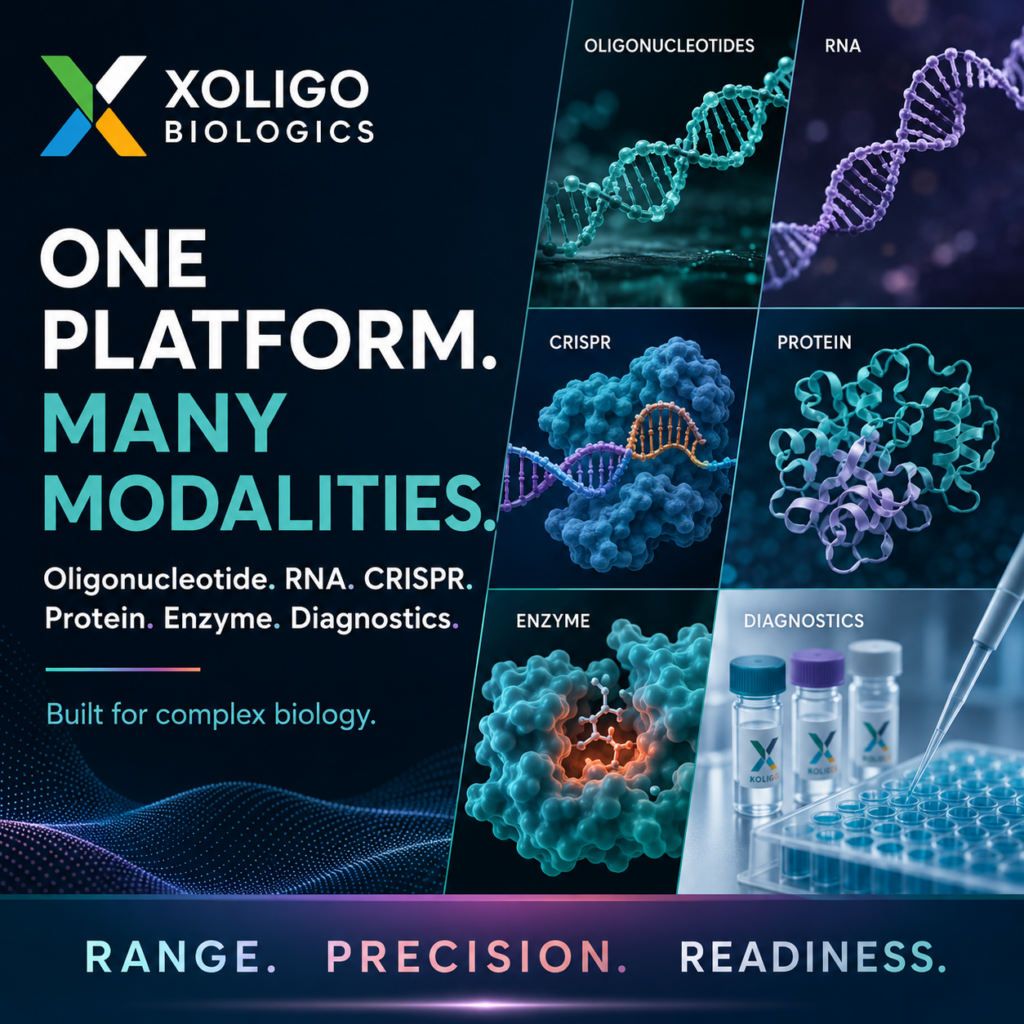
A Cas protein may be needed for gene editing.
A VHH may be needed for a protein-oligo conjugate.
A protein standard may be needed for assay comparability.
An antibody fragment may become a targeting or detection component.
Xoligo supports these modalities through expression, fermentation, purification, analytical characterization, residual impurity testing, endotoxin reduction, activity assays, binding assays, stability support, and transfer packages.
This hybrid capability is what makes Xoligo different from a narrow oligo supplier.
FAQ: Xoligo Modalities
1. What modalities does Xoligo support?
Xoligo supports oligonucleotides, ASOs, siRNA, miRNA and RNAi components, aptamers, guide RNAs, mRNA, self-amplifying RNA, circular RNA, modified oligos, diagnostic primers and probes, nucleic acid standards, RNA vaccine components, recombinant enzymes, CRISPR proteins, diagnostic reagents, antibody fragments, and protein-oligo systems.
2. Is Xoligo mainly an oligonucleotide company?
Xoligo begins with an oligo-forward identity, but the company is broader than oligonucleotide development alone. Xoligo supports the component systems around oligos, including RNA workflows, recombinant enzymes, CRISPR proteins, diagnostic reagents, analytical testing, stability, and transfer documentation.
3. How does modality development differ from ordinary reagent supply?
Reagent supply focuses on delivering a material. Modality development focuses on whether that material performs in the intended system, remains stable, can be characterized, supports comparability, and can move toward the next development stage.
4. Can Xoligo support both therapeutic and diagnostic modalities?
Yes. Many Xoligo programs sit between therapeutic and diagnostic categories. For example, guide RNAs, RNA controls, recombinant enzymes, diagnostic probes, and protein-oligo systems may be relevant to both genetic medicine and diagnostic workflows.
5. Can Xoligo help choose the right modality path?
In many programs, yes. Xoligo can help customers evaluate whether the development path should focus on oligo modification, RNA workflow design, enzyme compatibility, CRISPR component matching, diagnostic reagent performance, stability, or pre-GMP documentation.
6. Does Xoligo support pre-GMP modality development?
Yes. Xoligo supports pre-GMP bridge material and development packages for oligos, RNA, enzymes, proteins, CRISPR components, diagnostics, standards, and controls. The goal is to help programs move beyond informal research material without prematurely overbuilding GMP systems.
7. Can Xoligo support rare or niche modalities?
That is one of the strongest fits. Xoligo is designed for hybrid and niche component programs, including protein-oligo conjugates, CRISPR diagnostic systems, RNA workflow enzyme sets, aptamer-protein systems, matched controls, modified oligos, and unusual diagnostic reagent architectures.
8. How does Xoligo connect modalities to analytics?
Each modality requires a different analytical strategy. ASOs may need impurity profiling. RNA may need integrity and fragment analysis. Enzymes may need activity assays. CRISPR systems may need guide compatibility testing. Diagnostic probes may need labelled-species analysis. Xoligo builds analytics around the modality.
9. Can one Xoligo program include multiple modalities?
Often, yes. A single program may involve mRNA, plasmid template, IVT enzymes, RNA controls, LNP compatibility, and stability. Another may involve Cas enzyme, guide RNA, reporter oligo, diagnostic control, and functional assay. Xoligo is built for these connected programs.
10. Why does Xoligo organize services by modality?
Buyers often think by molecule type first. A company may know it has an ASO, siRNA, gRNA, mRNA, aptamer, Cas enzyme, diagnostic probe, or RNA control problem before it knows which service category fits. The Modalities section helps customers find the right path.
11. Can Xoligo support modality transfer to another CDMO?
Yes. Xoligo can support transfer packages that help another CDMO, diagnostic manufacturer, formulation partner, or internal team understand the process, analytical data, stability, functional performance, and risks associated with a modality.
12. How early should modality planning begin?
Earlier than most teams expect. Decisions made during sequence design, modification selection, construct design, enzyme sourcing, or early analytical planning can influence scale-up, stability, comparability, and transfer later.
13. What is the most niche modality Xoligo can support?
One specialized example is a matched CRISPR diagnostic component system that includes Cas enzyme, guide RNA, reporter oligo, target control, RNA standard, enzyme activity assay, lyophilization-readiness, and transfer documentation. That is not one modality alone; it is a coordinated component system.
Xoligo Biologics 是一家面向遗传医学、RNA 疗法、CRISPR、诊断试剂和精准生物制造的 Component CDMO。我们的 Modalities 平台覆盖 ASO、siRNA、gRNA、mRNA、saRNA、circRNA、适配体、修饰寡核苷酸、诊断引物探针、核酸标准品、重组酶、Cas 蛋白和蛋白-寡核苷酸系统。Xoligo 的优势不是只提供单一分子,而是把分析、稳定性、功能测试、pre-GMP 材料和技术转移连接成完整开发路径。
Why Xoligo? Why are you asking?
Xoligo supports modalities with the full component system in mind.
We understand oligonucleotides.
We understand RNA.
We understand CRISPR systems.
We understand enzymes.
We understand proteins.
We understand diagnostic reagents.
We understand analytical characterization.
We understand stability.
We understand pre-GMP bridge material.
We understand CMC transfer.
That matters because modern modalities rarely succeed alone.
An ASO depends on chemistry and analytics. An siRNA depends on duplex behavior and stability. An mRNA depends on plasmid and enzyme workflow. A guide RNA depends on Cas compatibility. A diagnostic probe depends on assay performance. A protein-oligo conjugate depends on both molecular sides working together.
Xoligo helps customers develop the modality and the surrounding system.
From Molecule Type to Development Path
The Modalities section exists because every molecule type creates a different development path.
A strand is not always just a strand.
An RNA is not always just an RNA.
A protein is not always just a protein.
An enzyme is not always just an enzyme.
A diagnostic component is not always just a reagent.
Each modality carries its own biology, chemistry, process risks, analytical needs, stability questions, and transfer requirements.
Xoligo Biologics helps companies navigate those differences with component-level development support.
Because in genetic medicine, diagnostics, and precision biomanufacturing, the modality is only the beginning.
The system around it determines whether it can move forward.
Learn more about our –> Diagnostic Enzyme Contract Manufacturing